 Domain SearchInstantly check and register your perfect .pk or international domain
 Web HostingGet a .pk domain for as low as PKR 467
 cPanel HostingUser-friendly hosting powered by cPanel
 Reseller HostingLaunch your own hosting business with minimal technical requirements
 Windows HostingOptimized for Windows-based applications and websites
 Affiliate ProgramEarn referral commissions by promoting our services
 WordPress HostingFast & Reliable WordPress Hosting
 Domain TransferMigrate your existing domain seamlessly with zero downtime.
 All DomainsAccess 324+ top-level domains (TLDs) worldwide from a single platform
 Whois LookupIdentify the owner of any domain using our whois and rdap lookup tool
 Managed VPS Hosting
 AI Website BuilderCreate beautiful websites effortlessly using intuitive drag-and-drop features
 Online ShopLaunch a professional online shop with no technical skills required
 BlogDiscover expert guides on hosting, websites, SEO, and digital growth strategies
 ContactGet instant assistance via live chat or email
 SupportAccess help articles, tutorials, and service documentation
 SSL CertificatesEncrypt data, build trust, and boost SEO.
You have built something with Python; maybe it is a Django application, a Flask API, a data dashboard, or a simple script you want to run on a schedule.
It works on your computer, but now you need it online so other people can use it. The moment you start looking for hosting, it’s easy to feel a bit stranded.
Luckily, there are platforms that handle everything for you, servers you manage yourself, and cloud services that sit somewhere in between.
The right pick depends on what you are building and how much control you want.
Our list covers five hosting platforms that work well for Python projects, each suited to a different kind of user.
5 Best Python Hosting Platforms
| Platform | Best for | Hosting Type | Starting Price | Python Support |
| Truehost | Affordable local hosting | VPS / Shared | From ₨282.65 | Full support on VPS and shared plans |
| PythonAnywhere | Beginners and pure Python projects | PaaS | Free tier, paid from $10/month | Built exclusively for Python |
| Kamatera | Scalable cloud VPS with full control | IaaS / Cloud VPS | From $4/month | Full root access, any Python version |
| Hostinger VPS | Budget-friendly VPS with easy setup | VPS | From $5.52/month | Full root access, one-click deployments |
| Render | Simple Git-based deployments | PaaS | Free tier, paid from $25/month | Unlimited seats & services, 25 GB bandwidth,Full-stack previews, Horizontal autoscaling, Isolated environments |
The prices in the table may be subject to change. So, check out the specific provider’s website for the most current pricing.
1) Truehost
When you host with us, you get friendly support that is there for you when something goes wrong. We include free SSL certificates so your site is secure from day one.
Our cPanel dashboard is super easy to use. It includes one-click installs via Softaculous. You also get automated daily backups, so your data is never at risk.
We offer different plans depending on what you need. The Starter plan costs ₨282.65/ month and works well for new websites, portfolios, student projects, and blogs.
The Pro plan at ₨296.78/month is better for small businesses and company websites.
The Unlimited plan at ₨4,149.77/month handles agencies, developers, and eCommerce stores with heavy traffic needs.
Every plan includes high-speed SSD storage, free daily backups, unlimited email accounts, and support for Python and Node.js.
For developers, we provide full Git integration, secure SSH and SFTP access, cron jobs, and staging environments.
You can run Django, Flask, or FastAPI applications without having to fight the platform.
For Python hosting specifically, our VPS options give you full root access so you can install any Python version and any library your project needs.
You are not locked into a specific framework or version. So if you are running a simple script or a full production application, our infrastructure handles it.
We also keep costs predictable. Our renewal prices stay low, and we offer loyalty credit to reduce your next bill.
If you are moving from another host, we will transfer your site for free.
2) PythonAnywhere
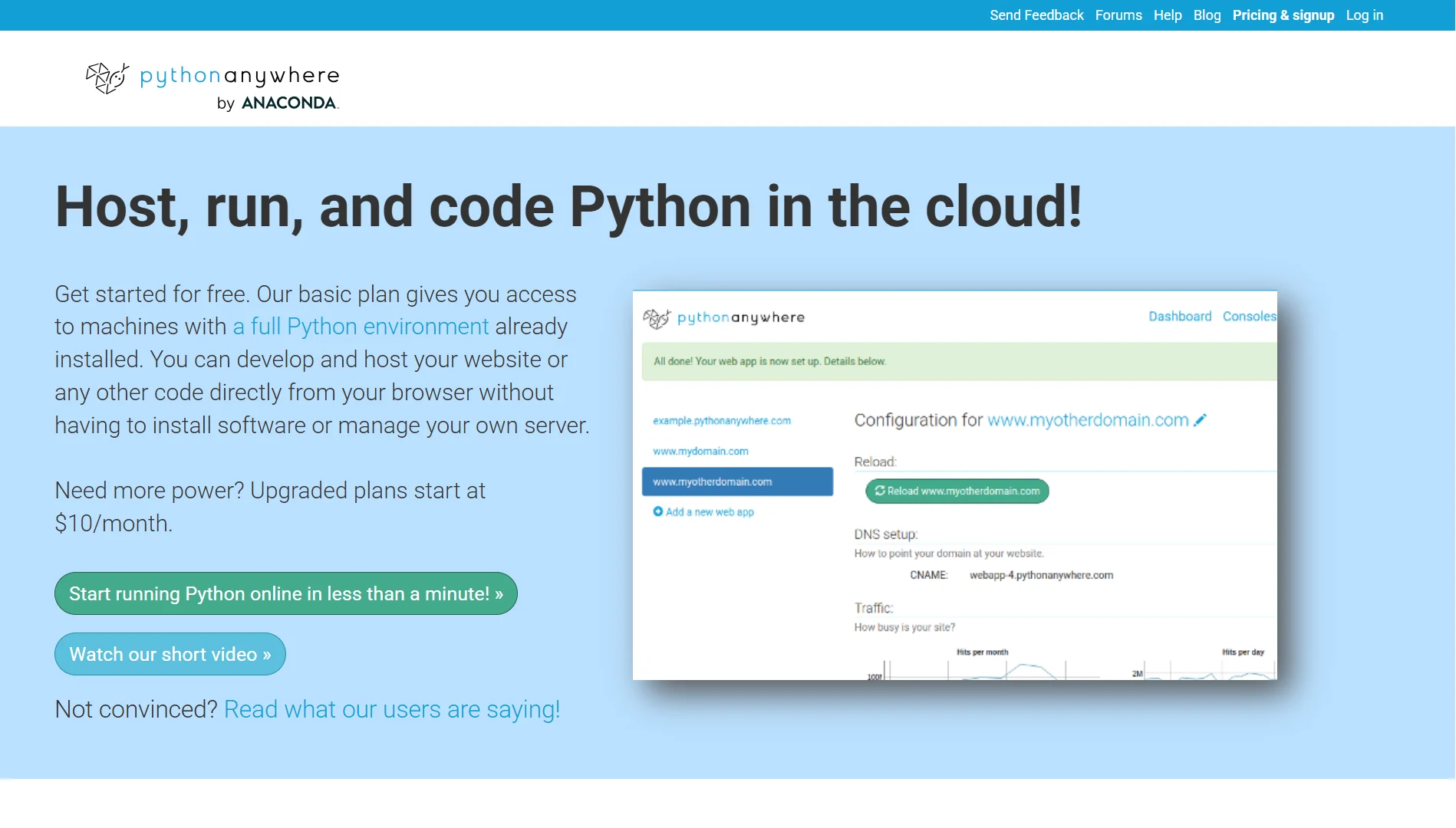
PythonAnywhere makes Python hosting simple. You do not manage a server. You do not configure web servers or install security patches. You write your code, upload it, and your application runs.
The whole environment lives in your browser, which means you can code from any computer with an internet connection.
The free tier gives you a working Python environment with a web app at yourusername.pythonanywhere.com.
You get Python consoles, a code editor, and enough resources to run small projects. For beginners learning Django or Flask, this removes almost every barrier to getting something online.
The paid Developer plan at $10 per month gives you a custom domain, more CPU seconds, and the ability to handle a website with around 150,000 hits per day.
PythonAnywhere supports Django, Flask, web2py, and Bottle with quickstart installers. If you use another WSGI framework, it is likely already installed.
The platform runs on Amazon EC2 infrastructure and gives you access to powerful servers without paying for hardware you are not using.
You can schedule tasks to run Python scripts periodically, which is useful for scraping, data processing, or automation jobs.
There are real limitations to understand. PythonAnywhere uses a network filesystem, so file-heavy operations can be slower than on a dedicated VPS.
Worker counts are limited by plan, which means concurrent requests queue up when traffic spikes. Free accounts now have community-only support, and scheduled tasks moved to paid tiers in 2026.
But for what it does, PythonAnywhere delivers: you get a working Python hosting environment without having to touch a terminal if you do not want to.
3) Kamatera
Kamatera is a cloud provider that gives you full control over your server at a low starting price.
You pick your data center location, your operating system, your CPU, RAM, and storage.
A basic configuration with 1 vCPU, 1 GB RAM, and 20 GB NVMe storage costs $4 per month. That price includes 5 TB of traffic.
The real appeal here is flexibility. Kamatera bills hourly for some plans, so you can spin up a powerful server for a few hours of heavy processing and then scale it back down.
You pay only for what you use.
This suits Python workloads that are spiky rather than constant, like batch data processing, machine learning training runs, or temporary testing environments.
You get root access and full control over the operating system. You install Python yourself, create virtual environments, set up systemd services, and configure your web server.
This is not a managed platform. You need to know your way around Linux or be willing to learn.
The tradeoff is complete freedom to install any Python version, any library, and any stack you want.
Kamatera offers a 30-day free trial with $100 in service credits, giving you room to test production workloads and verify compatibility before committing.
They have data centers in North America, Europe, Asia, and the Middle East. Support is available 24/7 through chat, tickets, and phone.
For Python developers who want a VPS they fully control without paying enterprise prices, Kamatera is a solid choice.
The hourly billing option makes it especially attractive for projects with unpredictable resource needs.
4) Hostinger VPS
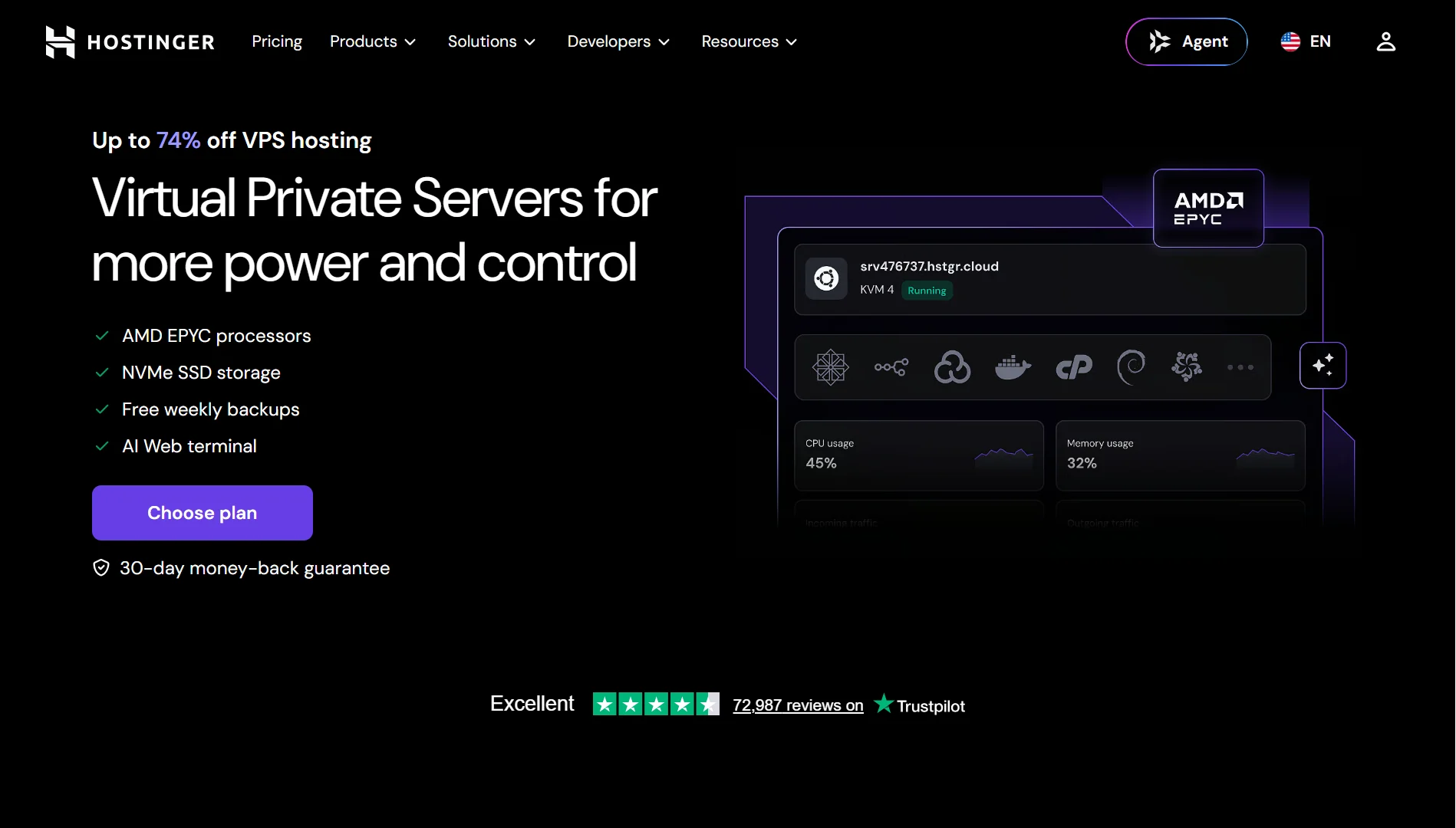
Hostinger has built its reputation on affordable, easy-to-use hosting, and its VPS plans continue that approach. Prices start at $5.52 per month for the KVM 1 plan, with 1 vCPU, 4 GB of RAM, and 50 GB of NVMe storage.
That is a lot of RAM for the price, making Hostinger a practical option for Python applications that need more memory than a typical budget VPS provides.
The setup process is simpler than most VPS providers. Hostinger offers a custom control panel called hPanel, and you can deploy popular applications with a single click. Python is not pre-installed on every template, but installing it takes a few terminal commands.
Once it is running, you have full root access and can configure your environment however you like.
Hostinger includes free weekly backups, a managed firewall, DDoS protection, and a browser-based terminal.
The AI web terminal lets you run commands or use natural language prompts to manage your server.
For developers who want the power of a VPS without the usual setup friction, this is a good balance.
The KVM 2 plan at $7.64 per month gives you 2 vCPU cores, 8 GB RAM, and 100 GB NVMe storage. That handles medium-scale Python applications comfortably.
If you are running a Django site, a FastAPI service, or a data processing pipeline, the hardware is more than adequate.
Data centers are available in the US, UK, France, India, Singapore, Brazil, and other locations, so you can pick a server close to your users.
Performance testing shows Hostinger VPS plans are consistent, with a consistency score of 74 out of 100 across multiple trials. That means you can expect reliable performance without wide variations between servers.
The main limitation is that Hostinger VPS is unmanaged, so you are responsible for security updates, application deployment, and troubleshooting. If you are comfortable with that, the price-to-performance ratio is hard to beat.
5) Render
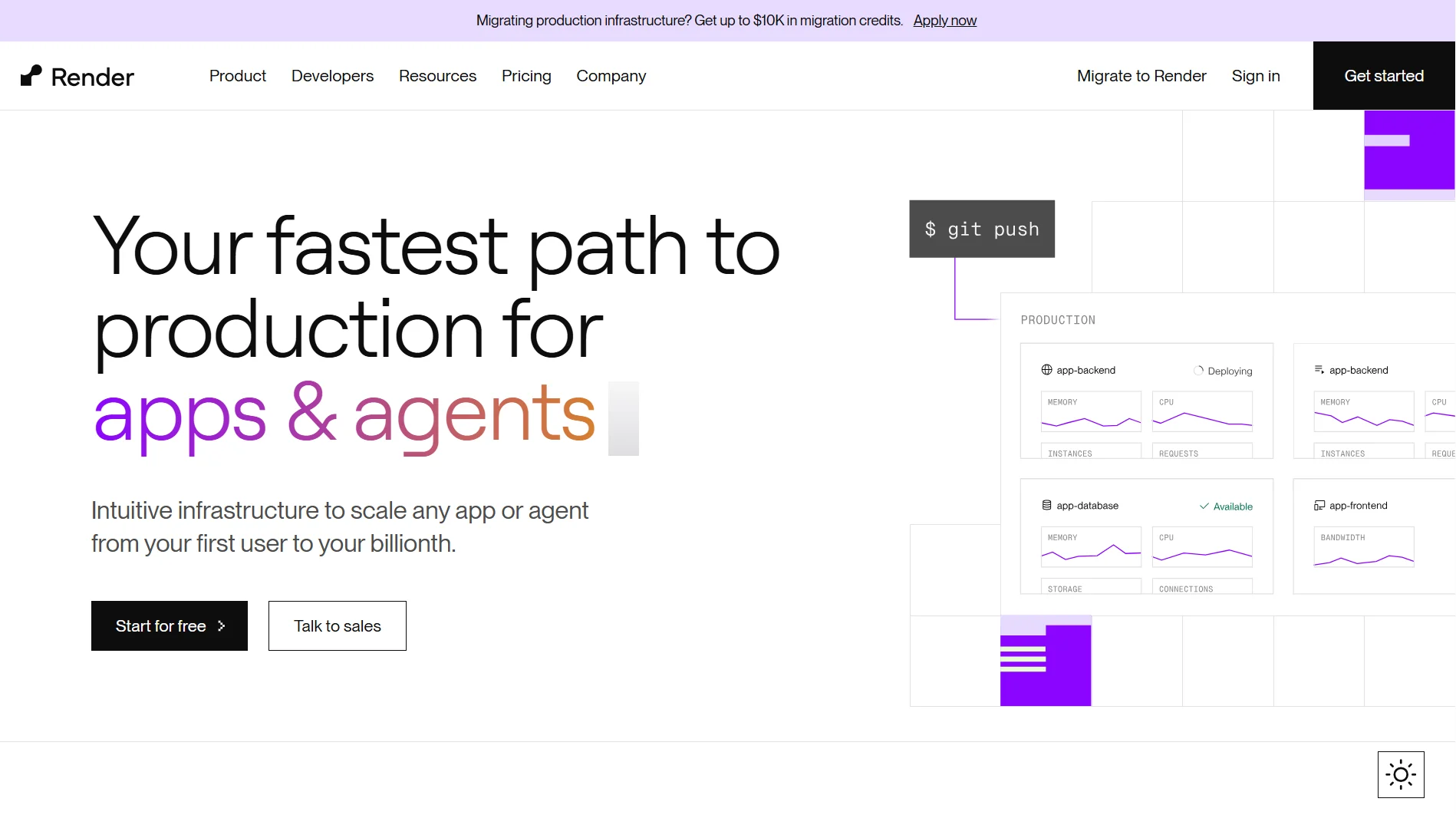
Render takes the complexity out of deploying Python applications. You connect your Git repository, tell Render how to build and start your app, and it handles everything else.
There are no servers to manage, no operating systems to patch, no web server configuration. You push code, and your application deploys automatically.
The platform supports Django, Flask, FastAPI, and other Python frameworks via native runtimes.
You define your build command, typically pip install -r requirements.txt, and your start command, like gunicorn app:app or uvicorn main:app.
Render runs your application on infrastructure it manages. You get automatic HTTPS, a .onrender.com URL, and the ability to attach custom domains.
Render offers a free tier for static sites and some service types, with paid plans starting at $25 per month for web services.
The pricing structure is based on the resources your application uses.
For Python projects that need background workers, cron jobs, or managed PostgreSQL databases, Render provides those as first-class services within the same platform.
Preview environments are one of Render’s strongest features.
Every pull request can spin up an ephemeral copy of your entire application architecture, including databases and services, so you can test changes before merging.
This workflow typically requires significant DevOps effort to set up, but Render automates it.
The downside is that you cannot install arbitrary system packages or configure the kernel. You work within Render’s supported runtimes and services.
For most Python web applications, this is not a limitation. If your project fits within the platform’s model, Render removes almost all operational overhead.
How to Choose the Best Python Hosting Platform:
- Framework compatibility: Confirm it supports Django, Flask, or FastAPI.
- Ease of use: PythonAnywhere and Render are beginner-friendly. Truehost VPS, Kamatera, and Hostinger VPS require server management.
- Pricing: Check what you pay after the intro period. Pay-per-use suits spiky workloads; flat rates suit always-on apps.
- Scalability: PaaS scales by upgrading your plan. VPS scaling via resizing may cause downtime.
- Python version support: VPS lets you install any version. PaaS may lag behind the latest releases.
- Database support: Render includes managed PostgreSQL. VPS lets you install your own. PythonAnywhere includes MySQL on most plans.
- Deployment workflow: Render and Hostinger VPS support Git auto-deploy. Truehost and Kamatera give you full control.
- Performance: Watch for cold starts on free PaaS tiers. VPS gives consistent performance. Check uptime SLAs.
- Security: Look for SSL, firewalls, DDoS protection, and backups. Truehost includes free SSL and daily backups.
- Monitoring & logs: Render includes built-in logs and metrics. VPS requires your own monitoring setup. PythonAnywhere offers basic logging.
Get Started with the Best Python Web Hosting
If you are ready to put your Python project online, we can help. At Truehost, we make hosting accessible without sacrificing the features developers need.
Our plans start at ₨282.65, and every plan includes Python support, free SSL, daily backups, and a cPanel dashboard that keeps management simple.
You do not need to wait days for provisioning or fight with complicated setup processes.
Plus, our support team is available when you need help, and we transfer existing sites from other hosts for free.
For Python developers, our VPS options give you full root access, SSD storage, and the ability to install any Python version or library.
You can run Django, Flask, FastAPI, or custom scripts without limitations. Cron jobs handle scheduled tasks. SSH and SFTP give you secure access. Git integration keeps your deployment workflow smooth.
We also keep costs reasonable over time.
If you are a startup, non-profit, eCommerce store, web designer, marketing agency, blogger, or freelancer, get our starter hosting plan and start building.