 Domain SearchInstantly check and register your perfect .pk or international domain
 Web HostingGet a .pk domain for as low as PKR 467
 cPanel HostingUser-friendly hosting powered by cPanel
 Reseller HostingLaunch your own hosting business with minimal technical requirements
 Windows HostingOptimized for Windows-based applications and websites
 Affiliate ProgramEarn referral commissions by promoting our services
 WordPress HostingFast & Reliable WordPress Hosting
 Domain TransferMigrate your existing domain seamlessly with zero downtime.
 All DomainsAccess 324+ top-level domains (TLDs) worldwide from a single platform
 Whois LookupIdentify the owner of any domain using our whois and rdap lookup tool
 Managed VPS Hosting
 AI Website BuilderCreate beautiful websites effortlessly using intuitive drag-and-drop features
 Online ShopLaunch a professional online shop with no technical skills required
 BlogDiscover expert guides on hosting, websites, SEO, and digital growth strategies
 ContactGet instant assistance via live chat or email
 SupportAccess help articles, tutorials, and service documentation
 SSL CertificatesEncrypt data, build trust, and boost SEO.
Are you building a website or starting a business? You’ve probably seen the options: email hosting and web hosting.
They sound similar, and many providers bundle them together, but they serve different purposes.
Email hosting is a service that stores, sends, and receives your emails. Instead of using a free service like Gmail or Yahoo, email hosting gives you the ability to have professional, custom-branded email addresses like [email protected].
You need it if you want to look credible to clients, have control over your email data, and access advanced security features that protect your business communications.
Web hosting, on the other hand, is the service that stores all the files, images, and content that make up your website.
You need web hosting if you want to publish a website, blog, or online store that people can visit anytime.
Your business needs both to operate effectively online. The website acts as your public face, while a professional email address is how you communicate with customers, partners, and suppliers.
Email Hosting vs Web Hosting: 9 Differences
| Feature | Email Hosting | Web Hosting |
| Purpose | Manage and store business emails. | Store and deliver website files and content. |
| Cost | Cost is based on the number of mailboxes and storage. Truehost’s Starter plan is ₨282.65 . | Cost is based on server resources like storage and bandwidth. Truehost’s Starter web hosting is ₨282.65 . |
| Storage | Allocated per mailbox for emails, files, and attachments. | Allocated for website files, images, databases, and logs. |
| How Resources Work | Dedicated resources ensure reliable email performance, independent of your website. | Resources are shared among websites on the same server (in shared hosting), which can sometimes affect performance. |
| Security | Advanced, with features like anti-spam, anti-virus, two-factor authentication (2FA), and end-to-end encryption. | Focuses on protecting your website from hacks, with firewalls, SSL certificates, and malware scanning. |
| Management Interface | A dedicated control panel for managing mailboxes, creating aliases, and setting forwarding rules. | Control panels like cPanel for managing domains, files, and databases. |
| Downtime Impact | Outages directly halt all business communication and support. | Outages make your website inaccessible to visitors. |
| Scalability | Easily add more storage or mailboxes as your team grows. | Upgrade to plans with more CPU, RAM, or storage as your website traffic increases. |
| Provider | Specialized providers or add-on services from hosting companies. | Providers that specialize in server and infrastructure management. |
1) Purpose
The main purpose of web hosting is to make your website accessible on the internet. It powers your online presence, ensuring your content loads when people visit your URL.
Every website needs web hosting to be visible. Your web host manages the server space and technology so you can focus on other business needs.

Email hosting manages your email communication. It’s the backbone for sending and receiving email messages.
It provides dedicated mail servers, inbox storage, and the infrastructure to keep your business emails flowing.
While it can be part of a web hosting package, its purpose is strictly about communication.
2) Cost
Pricing is one of the clearest differentiators between the two services. Web hosting is typically priced based on the server resources you need.
For example, a basic plan like the Starter web hosting from Truehost costs ₨282.65.
This cost covers the physical or cloud space, bandwidth, and tools needed to keep your site running.
Email hosting pricing is usually based on the number of user accounts (mailboxes) you need and the storage allocated to each. A simple setup can be very affordable.
For instance, Truehost’s cheapest email hosting plan is ₨282.65.
3) Storage
In web hosting, storage is the amount of server space you have for all your website files. This includes images, videos, HTML, CSS files, databases, and more.
The storage limit dictates how large your website can grow. A photographer’s portfolio with hundreds of high-resolution images will need significantly more storage than a simple text-based blog.
For email hosting, storage is the space allocated to your individual mailboxes. It holds every email you send and receive, along with any attachments.
When you hit this limit, you might not be able to send or receive new messages until you clear up space.
Business email hosting, like that from Truehost, often provides ample storage that can grow with your business.
For example, our Workplace Pro plan includes 15 GB of total storage across 3 mailboxes (5 GB per mailbox), plus additional Drive storage for files and collaboration tools.
4) How Resources Work

When you use web hosting, particularly shared hosting, your website shares the server’s physical resources with other websites. The server has a fixed amount of CPU and RAM.
If another site on the same server has a traffic spike, it can use up resources, potentially slowing down your own site. This is a common limitation of budget-friendly web hosting.
Email hosting is designed to be more independent. Dedicated email hosting runs on infrastructure that is specifically built for mail delivery.
Server resources are allocated to handle your email traffic, so your email performance is generally unaffected by what happens with your website.
If your web hosting goes down, your email remains operational, ensuring you can still communicate.
5) Security
Security protocols differ based on what each service protects. Web hosting providers focus on securing your website from online threats.
They typically offer features like free SSL certificates (to encrypt data between a visitor and your site), firewalls to block malicious traffic, and tools to protect against DDoS attacks.
Email hosting includes features designed to protect your messages, such as enterprise-level anti-spam and anti-virus filters that stop malicious emails from reaching your inbox.
Professional email hosting also supports advanced authentication methods like SPF, DKIM, and DMARC to prevent email spoofing and keep important messages out of spam folders.
Two-factor authentication (2FA) is also common and helps prevent unauthorized access to your accounts.
6) Management Interface
With web hosting, you usually get a control panel like cPanel. This is where you manage your entire hosting account: you can set up domains, access file managers, create databases, and install applications like WordPress.
Email hosting has its own interface. This is where you log in to manage everything related to your mailboxes.
You can create new email accounts for staff, set up email forwarding, create aliases, manage spam filters, and access your webmail.
While some web hosting control panels include email management tools, a dedicated email hosting interface is often more streamlined and feature-rich.
7) Downtime Impact
Downtime impact shows how critical each service is to your daily operations. If your web hosting goes down, your website becomes inaccessible.
If your email hosting goes down, your business communication chain breaks. You can’t send proposals to new clients, respond to support tickets, or receive new orders.
An email outage is critical for a business because it can stop your team from working effectively and alienate your customers.
A web server outage that only takes a site offline is manageable; one that also cuts off your email means missed orders and unanswered support requests, all from a single point of failure.
8) Scalability
Scalability is about how easily a service can grow with your needs. You scale web hosting by upgrading to a better plan, like moving from a starter to a pro plan on Truehost, or from shared hosting to a VPS.
This gives your website more CPU, RAM, and storage to handle increased traffic.
Email hosting scales by allowing you to add more mailboxes as your team grows, or by increasing the storage quota for existing mailboxes.
Truehost’s email plans, for instance, come in tiers like Pro and Business, which offer more mailboxes and larger storage, ensuring your communication platform can expand as you hire new staff.
9) Provider
A web hosting provider like Truehost specializes in server and infrastructure management. They maintain data centers, server hardware, network connections, and website security.
Their primary expertise is in keeping websites online, fast, and secure.
An email hosting provider can be a specialized company or a service offered by the web host. Providers like Truehost offer email hosting as a standalone service.
A dedicated email hosting provider focuses on mail delivery, uptime, and security, with separate infrastructure from web hosting services to ensure independence.
Which One Is Best For You?
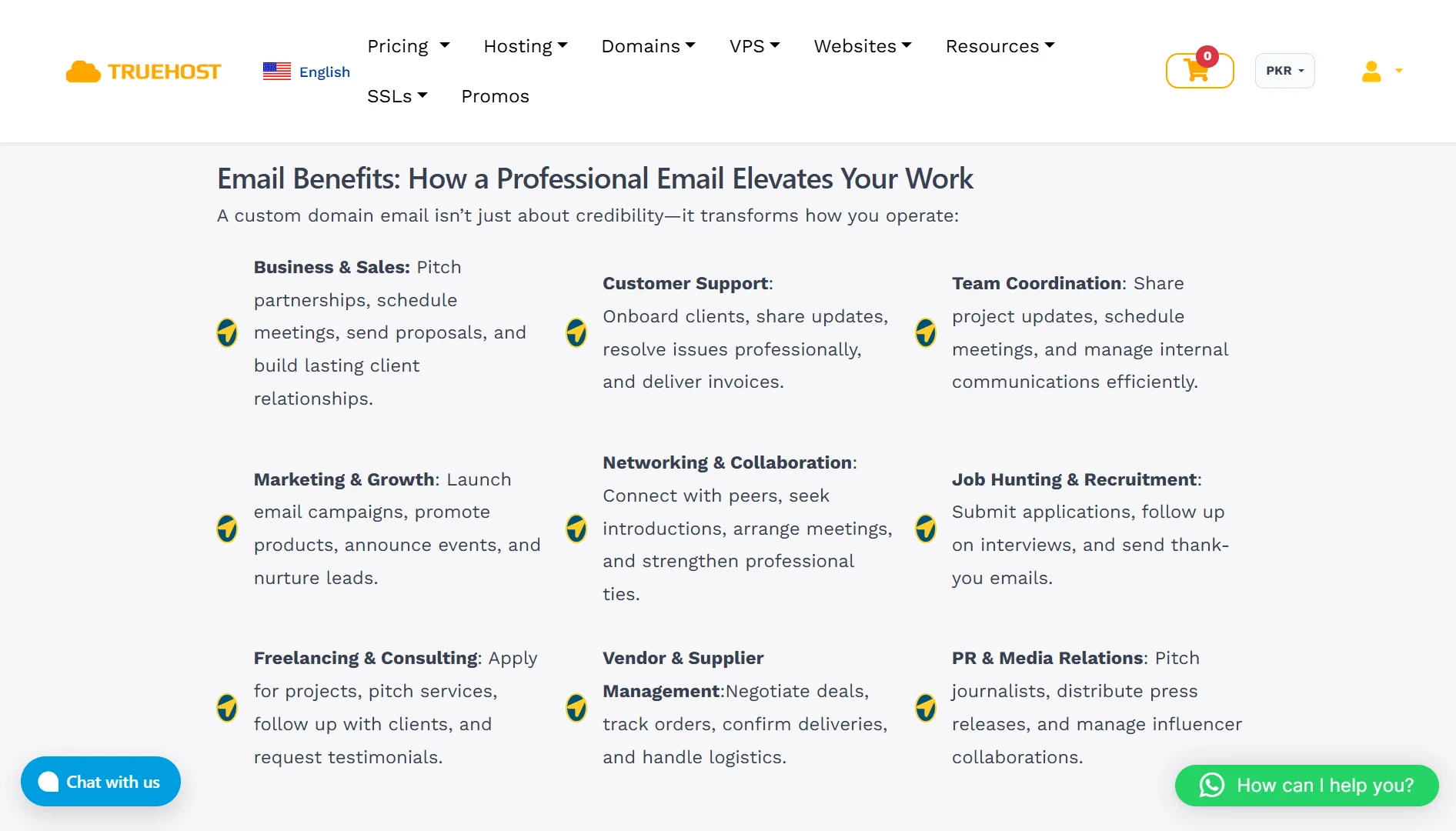
Email hosting is ideal for:
- Businesses that rely heavily on email for sales and support. If your work involves pitching, invoicing, and resolving client issues by email, you need the reliability and professionalism of email hosting.
- Teams that need to collaborate. Features like shared calendars and contacts are built into professional email hosting.
- Anyone who wants to build a credible brand. A custom domain email address builds trust and is a standard expectation for any serious venture
Web hosting is ideal for:
- Publishing content online. If you want to share a blog, a portfolio, or information about your company, you need web hosting.
- Running an e-commerce store. You need a place to host your product catalog, shopping cart, and payment processing.
- Creating an online community. Websites with forums or membership areas require robust web hosting.
Do You Need Both?
In almost every case, if you are running a business, the answer is yes. A website is your public storefront, and a professional email address is how you talk to customers. They are two sides of the same coin.
You don’t have to get them from the same provider. You can host your website with one company and your email with another.
Many businesses do this to get the best service for each need. However, keeping them together can simplify management and billing.
Email Hosting vs Web Hosting FAQs
Can I host my website and email separately?
Yes. You can buy web hosting from one company and email hosting from another. Your domain name then points to each service separately for email and website traffic.
Can I use the same provider for both web hosting and email hosting?
Many companies, like Truehost, offer both services. This is often convenient because you can manage everything from a single dashboard and only have one billing account.
Is it cheaper to buy email and web hosting together?
Bundling can be cheaper, as many providers offer discounts on combined packages. However, this is not always the case. For a business, the extra cost of a reliable, separate email hosting service is often worth the investment in security and uptime.
Does Google do email hosting?
Yes, Google offers a business email hosting service called Google Workspace. It provides professional email with a custom domain as part of a suite of productivity tools.
Is email hosting safer than web hosting?
They offer different types of safety. Email hosting provides advanced security to protect your communications from spam, phishing, and spoofing. Web hosting protects your website from being hacked. Both are critical, but for different reasons.
Ready to Get Started with Email Hosting?
A professional email address is the first step in building trust and presenting a credible brand. With Truehost, you get more than just an inbox. You get a complete communication solution.
Our email hosting comes with all the features you need:
- Branded email addresses to reinforce your identity.
- Advanced security, including 2FA, anti-spam, and antivirus.
- Collaboration tools like calendars and contacts.
- Access anywhere via webmail or your phone.
We offer simple, transparent plans to suit every business. You can start small and scale as you grow.
Our Starter plan is ₨282.65 , the Pro plan is ₨296.78 , and the Businesss plan is ₨522.90 .
We have the right email solution for you. Get started with Truehost email hosting today and take your business communication to the next level.