 Domain SearchInstantly check and register your perfect .pk or international domain
 Web HostingGet a .pk domain for as low as PKR 467
 cPanel HostingUser-friendly hosting powered by cPanel
 Reseller HostingLaunch your own hosting business with minimal technical requirements
 Windows HostingOptimized for Windows-based applications and websites
 Affiliate ProgramEarn referral commissions by promoting our services
 WordPress HostingFast & Reliable WordPress Hosting
 Domain TransferMigrate your existing domain seamlessly with zero downtime.
 All DomainsAccess 324+ top-level domains (TLDs) worldwide from a single platform
 Whois LookupIdentify the owner of any domain using our whois and rdap lookup tool
 Managed VPS Hosting
 AI Website BuilderCreate beautiful websites effortlessly using intuitive drag-and-drop features
 Online ShopLaunch a professional online shop with no technical skills required
 BlogDiscover expert guides on hosting, websites, SEO, and digital growth strategies
 ContactGet instant assistance via live chat or email
 SupportAccess help articles, tutorials, and service documentation
 SSL CertificatesEncrypt data, build trust, and boost SEO.
Building a website can be genuinely simple when you only need a few pages, some basic information, and standard features. Website builders and off-the-shelf themes handle that well without requiring anyone to write a line of code.
Websites tend to get harder to manage as they become more central to a business and start needing more advanced functionality. That’s usually when a website development expert becomes useful: someone who can help with complex features, performance problems, security issues, third-party integrations, custom functionality, and technical problems that go beyond what standard tools were built to handle.
This article covers the signs that professional help may be worth considering, how to figure out what type of help you actually need, what to evaluate before hiring someone, what costs typically depend on, and mistakes worth avoiding along the way.
Already dealing with a technical issue you suspect needs a developer? Talk to Truehost Pakistan About Hosting and Performance
Signs You Need a Website Development Expert
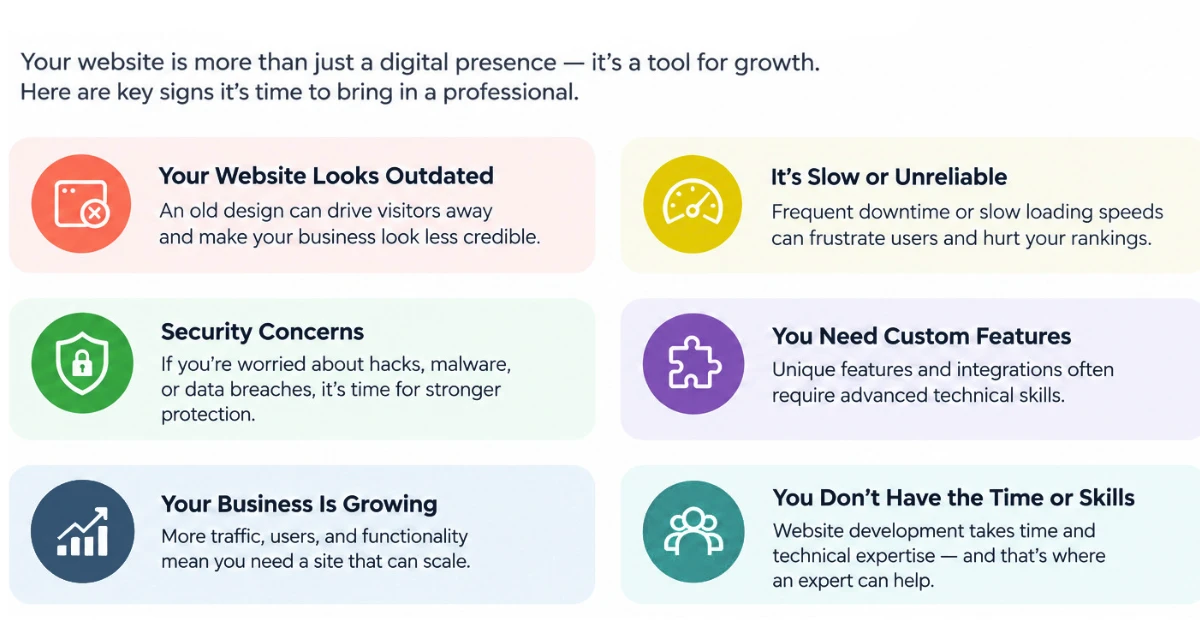
Not every website problem calls for a developer. But certain situations tend to signal that professional technical help would genuinely save time and prevent bigger problems down the line.
1) Your Website Needs Custom Features
Standard themes, plugins, and website builders cover a lot of ground, but not everything. Custom booking systems, customer dashboards, membership areas, advanced forms, calculators, and specialised ecommerce features often fall outside what an off-the-shelf plugin can reliably deliver.
There’s a real difference between configuring an existing feature and building something custom. Not every custom need requires fully custom software though. Sometimes existing plugins plus some configuration get you most of the way there, and a developer’s first job should be figuring out which category your requirement falls into.
2) Your Website Is Difficult to Maintain
Frequent technical problems, broken features, plugin conflicts, and recurring errors are worth paying attention to, especially if the same issue keeps coming back after you think you’ve fixed it.
Recurring problems often point to something underneath the surface: compatibility issues, outdated software, poor configuration, or a development problem a quick fix never actually addressed. Repeatedly patching the same symptom without understanding its cause tends to cost more time in the long run.
3) Your Website Is Too Slow
Slow page loading can come from several places at once: unoptimised code, large images, too many plugins, inefficient databases, third-party scripts, or the hosting and server configuration underneath it all. Google’s own Learn Performance resource walks through these factors if you want to understand what’s actually slowing a page down.
A developer can help diagnose where the slowdown is coming from rather than guessing. That said, hiring a developer doesn’t automatically make a website faster. If the real bottleneck is your hosting environment, no amount of code optimisation fixes that alone, which is part of why VPS hosting with more dedicated resources sometimes belongs alongside development work, not instead of it.
4) You Need to Connect Third-Party Tools
Payment gateways, CRM systems, email marketing platforms, inventory systems, accounting software, and booking platforms are common integration needs. Some can be handled with an existing plugin or connector app. Others need custom development, particularly when two systems need to exchange data in a way a generic connector doesn’t support.
This usually comes down to APIs (the interfaces that let two systems talk to each other), authentication, and data synchronisation. When an integration needs to handle these reliably and available plugins don’t quite fit, that’s a reasonable point to bring in development help.
5) Your Website Has Security Problems
Malware, suspicious activity, vulnerable plugins, unauthorized access attempts, and outdated software are all reasons to consider professional help, particularly if you’re not confident cleaning up the problem yourself. OWASP’s Top Ten project is a widely referenced resource on common web application security risks worth reviewing.
Good security practice includes keeping software updated, securing administrator accounts, reviewing known vulnerabilities, maintaining backups, and properly cleaning a compromised website. Security isn’t only about the website’s code either. It involves hosting, server configuration, plugins, themes, and user accounts too. No developer, and no server security setup, can guarantee complete security, only reduce risk and limit damage.
6) Your Website Is Not Mobile-Friendly
Poor mobile layout, awkward navigation, hard-to-tap buttons, and content that doesn’t display correctly are common complaints. Some of these are fixable through design or theme adjustments alone. More complex problems can require actual development work, particularly on older or heavily customised sites. MDN’s guide to responsive web design covers the underlying techniques. Testing across a genuine range of screen sizes matters more than people expect, since problems often only show up on specific devices.
7) You Are Planning a Major Website Redesign
Moving to a new platform, rebuilding an outdated site, or significantly improving functionality all involve more than changing how a website looks. A proper redesign touches existing functionality, content migration, databases, URLs, forms, integrations, backups, and testing, and missing any one can cause problems after launch. If you’re also changing web hosting as part of the redesign, that adds another layer of coordination with the website migration itself. Professional help tends to earn its cost here, mainly because the number of moving parts makes it easy to miss something without a structured process.
Key Factors to Evaluate Before Hiring a Website Development Expert
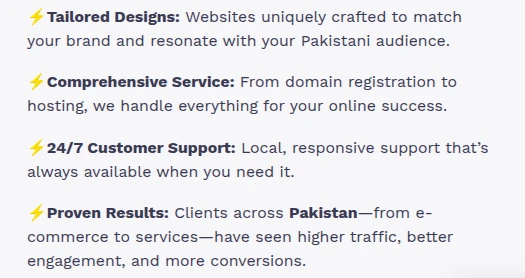
Recognising that you need help is only the first step. Evaluating the actual person or agency you’re considering matters just as much.
- Relevant experience. Look for someone who has worked on websites with similar functionality, industry requirements, and project complexity to yours, rather than judging purely by the number of projects they’ve completed.
- Technical skills. The developer should have real experience with whatever your project actually requires, whether that’s a specific programming language, CMS, ecommerce platform, API, database, or hosting environment. Skills should map to your project’s actual needs, not just sound impressive on paper.
- Portfolio. Previous work shows what quality and type of work to expect. Look for projects similar in complexity, functionality, platform, and industry, and judge more than visual appearance. Functionality, usability, and performance matter just as much as how a site looks.
- Communication. A good developer explains technical issues clearly, asks the right questions to understand your requirements, provides progress updates, and is upfront about changes, delays, or what’s included in the project.
- Problem-solving ability. Look for someone who identifies the actual cause of a problem rather than just patching its visible symptoms, since a fix that doesn’t address the root cause tends to resurface later.
- Security and performance knowledge. For any website that matters to your business, the developer should understand security practices, performance and speed optimisation, scalability, and backups. How much expertise you need here scales with how complex and important the website actually is.
- Ongoing support. Ask whether the developer offers support after launch for maintenance, updates, troubleshooting, security work, or performance improvements. This matters more for websites relying on custom systems or regular integrations, though not every website needs an ongoing support arrangement.
- Project cost and timeline. Get clarity upfront on expected cost, timeline, payment terms, deliverables, what’s included, what isn’t, and any potential additional costs. Defining scope before work starts avoids a lot of disagreement later.
- Ownership and access. Confirm who will own and control the website, source code, domain, hosting account, design files, databases, content, and any licenses involved. This should be settled before the project begins, not after.
How to Decide What Type of Website Development Help You Need
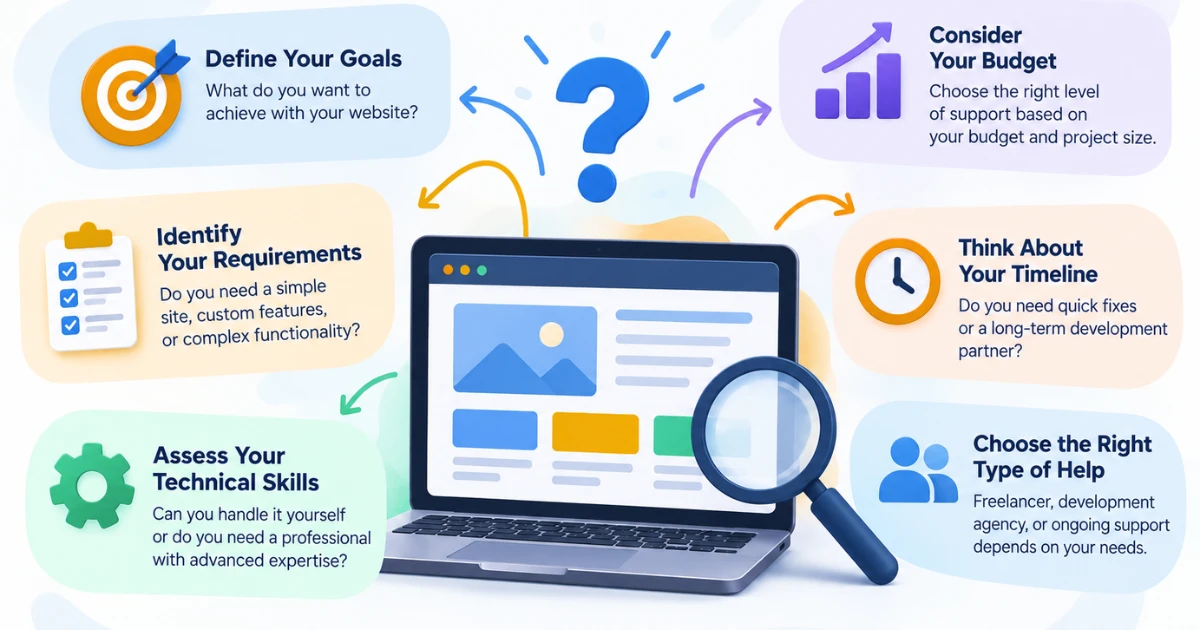
Not every website problem requires a full development project. The right type of support depends on what you’re actually trying to fix, build, or improve.
- For minor technical problems, you may only need help with a specific fix, some troubleshooting, resolving a plugin conflict, or a small functionality change. A minor issue doesn’t automatically mean the whole website needs rebuilding.
- For custom features, development becomes appropriate once standard themes, plugins, website builders, or integrations genuinely can’t deliver what you need. A good developer checks whether an existing solution can reliably meet the requirement before recommending anything fully custom.
- For major website changes, like large redesigns, platform changes, migrations, or significant functionality improvements, expect the project to require real planning, backups, testing, and technical oversight throughout, not just at the end.
- For ongoing technical requirements, websites that depend on regular integrations, custom systems, security updates, or performance work may benefit from an ongoing development and maintenance relationship rather than one-off project work. The right level of support should match how complex and important the website actually is to your business.
How Much Does It Cost to Hire a Website Development Expert?
There’s no single price for this. Cost depends heavily on the specifics of the project:
- Website size
- Project complexity
- Custom functionality
- Number of integrations
- Design requirements
- Development time
- Platform or technology used
- Migration requirements
- Ongoing maintenance needs
- Developer experience level
A simple website naturally costs less than one requiring custom systems, multiple integrations, advanced functionality, data migration, complex ecommerce features, or ongoing technical support. Rather than chasing the lowest quote, compare scope, deliverables, the developer’s relevant experience, timeline, and what support is included. A cheap quote that’s missing half of what you actually need often costs more once you account for the gaps.
Common Mistakes to Avoid When Hiring a Website Development Expert
1. Choosing based only on price. The cheapest option may lack the experience or support your project actually needs, but the most expensive option isn’t automatically the right choice either. Match the price to the scope and quality you actually need.
2. Not checking previous work. Reviewing past projects helps you judge whether a developer has genuinely handled websites similar to yours, rather than taking their word for it.
3. Not clearly defining the project. Unclear requirements lead to delays, unexpected costs, misunderstandings, scope creep, and disagreements. Clarify requirements, deliverables, responsibilities, and timelines before any work starts.
4. Ignoring ongoing support. Websites generally need updates, troubleshooting, security work, maintenance, and performance improvements after launch. Deciding how that gets handled before launch avoids a scramble later.
5. Focusing only on design. A visually appealing website still needs to actually work, perform well, stay secure, function across devices, support the features you need, and remain maintainable over time. Design matters, but it’s only one part of a website that actually works.
6. Not discussing ownership and access. Confirm who controls the website, domain, hosting account, source code, files, and databases before development begins, not after a dispute makes it urgent.
FAQs
Do I need a website development expert for a small business website?
Not necessarily. A small business with a straightforward website (basic pages, standard contact forms, simple content) can often manage things using standard tools and a website builder or common CMS. Professional help becomes more useful once you need custom functionality, integrations, or run into technical problems standard tools can’t resolve on their own.
Can a website developer fix an existing website?
Often, yes, though this depends on the platform, the specific problem, what access you can provide, and how technically complex the issue is. Some fixes are quick; others require deeper diagnosis, especially on older or heavily customised sites.
How do I know if my website needs custom development?
Start by checking whether an existing plugin, theme, or website builder feature can genuinely deliver what you need. If multiple existing tools can’t reliably produce the functionality, reliability, or integration you’re after, that’s a reasonable sign custom development is worth considering.
Should I hire a freelancer or a web development agency?
It depends on your project. Freelancers often work well for smaller, well-defined projects with a tighter budget and more direct communication. Agencies tend to suit larger or more complex projects needing multiple specialists, more structured processes, and broader ongoing support. Neither option is universally better; it comes down to your project’s size, complexity, budget, and how much ongoing support you expect to need.
Can a website development expert help with website hosting?
Yes, in some overlapping areas. Developers often help with hosting configuration, website migrations, diagnosing performance problems, understanding server requirements, and general technical troubleshooting. That said, hosting and development are separate services. A developer isn’t necessarily your hosting provider, and vice versa, even though the two areas frequently intersect on real projects.
How long does it take to develop a custom website?
There’s no single timeframe, since it depends on scope, features, design complexity, integrations, how much content needs preparing, how many rounds of revisions you expect, testing, and any migration involved. A small project might take a few weeks; a complex one with custom systems and integrations can take considerably longer.
What should I prepare before hiring a website development expert?
Have a clear sense of your website goals, required features, current platform, existing problems, needed integrations, budget, timeline, available content, access you can provide, and what deliverables you actually expect at the end. Walking into a first conversation with this ready tends to produce a much more accurate quote and timeline.
Ready to Hire a Website Development Expert?
Hiring a website development expert tends to make sense once a website needs more than basic pages and standard features, whether that’s custom functionality, integrations, performance problems, security concerns, a migration, or genuinely complex technical issues. Professional expertise can save real time and prevent costly mistakes on projects with enough moving parts that a wrong assumption early on becomes expensive to fix later.
Before deciding, weigh your website’s actual requirements, project complexity, budget, future plans, and the developer’s relevant experience, portfolio, technical skills, communication, and ongoing support against what your specific situation actually needs. If website performance or hosting capacity turns out to be part of the underlying problem, it’s worth addressing that alongside any development work rather than assuming code changes alone will fix it.