 Domain SearchInstantly check and register your perfect .pk or international domain
 Web HostingGet a .pk domain for as low as PKR 467
 cPanel HostingUser-friendly hosting powered by cPanel
 Reseller HostingLaunch your own hosting business with minimal technical requirements
 Windows HostingOptimized for Windows-based applications and websites
 Affiliate ProgramEarn referral commissions by promoting our services
 WordPress HostingFast & Reliable WordPress Hosting
 Domain TransferMigrate your existing domain seamlessly with zero downtime.
 All DomainsAccess 324+ top-level domains (TLDs) worldwide from a single platform
 Whois LookupIdentify the owner of any domain using our whois and rdap lookup tool
 Managed VPS Hosting
 AI Website BuilderCreate beautiful websites effortlessly using intuitive drag-and-drop features
 Online ShopLaunch a professional online shop with no technical skills required
 BlogDiscover expert guides on hosting, websites, SEO, and digital growth strategies
 ContactGet instant assistance via live chat or email
 SupportAccess help articles, tutorials, and service documentation
 SSL CertificatesEncrypt data, build trust, and boost SEO.
If you run a reseller hosting business with WHM (WebHost Manager), you may have noticed that cPanel has become more expensive over the years. In 2026, its monthly prices increased again, with plans now ranging from $29.99 to $69.99. Extra account fees can also add up quickly, especially for resellers managing dozens or hundreds of client websites.
Cost isn’t the only concern. Some users also find cPanel’s interface dated compared with newer control panels. Resellers may also want built-in tools for account isolation, backups, and modern PHP and Node.js applications.
The reseller hosting model remains the same: you rent server resources, divide them into hosting plans, and offer those plans to your customers under your own brand. Many platforms also work with tools such as WHMCS to automate account creation and billing.
The good news is that you now have several alternatives to cPanel. Here are seven options worth considering.
Quick comparison
| WHM Alternative | Best For | Pricing | Main Strength |
| DirectAdmin | Traditional resellers | Starts at $5/month | Closest WHM-style experience |
| Plesk | Agencies and professional resellers | Starts at $13.10 | Feature-rich ecosystem |
| CyberPanel | WordPress resellers | Free | LiteSpeed performance |
| HestiaCP | Budget-conscious users | Free | Lightweight and simple |
| ISPConfig | Multi-server operators | Free | Flexibility and scalability |
| InterWorx | High-volume hosting | Starts at $7.50 | Clustering and multi-tenancy |
| CloudPanel | Cloud/VPS-focused users | Free | Modern, lightweight stack |
1) DirectAdmin

DirectAdmin is the most direct structural match for WHM: separate Admin, Reseller, and User levels give it a familiar workflow for anyone migrating off cPanel.
Features:
- Reseller accounts for managing multiple customers
- Custom hosting packages and resource limits
- DNS and email management
- Free SSL support
- White-label branding for your hosting business
- WHMCS integration for billing and account automation
Pricing: DirectAdmin charges based on the server rather than the number of accounts.
Its retail plans include Personal PLUS at $5/month for up to 2 accounts, Lite at $15/month for up to 10 accounts, and Standard at $29/month with unlimited accounts and domains.
Businesses running multiple servers can also qualify for automatic bulk discounts, with savings of up to 40% at higher volumes.
Since there are no extra per-account charges, the cost per account becomes lower as you add more customers, making the pricing easier to predict as your reseller business grows.
Pros: Lower resource usage, predictable flat-rate pricing regardless of account count, reliable performance, and a familiar reseller structure.
Cons: Smaller ecosystem and market presence than cPanel, with a less polished feel in some areas.
Best for: Cost-conscious resellers moving away from WHM who want a familiar hosting management experience without per-account licensing creep.
2) Plesk
Plesk is a feature-rich commercial panel that runs on both Linux and Windows, with dedicated reseller functionality alongside broader site, domain, and subscription management.
Features:
- Reseller subscriptions for managing customer accounts
- White-label branding for your hosting business
- WordPress Toolkit for managing WordPress sites
- Docker support for running containerized applications
- Built-in security and server management tools
- Extensions marketplace for adding extra features
- Multi-server management from a central interface
Pricing: Plesk licenses per server rather than per account, across several editions (Web Admin, Pro, Web Host, and Web Host on bare metal).
2026 pricing runs roughly $13.10–$24.99/month for the lower Web Admin and Pro VPS tiers, up to $49.99–$59.99/month for the top Web Host tiers, figures that ticked up from 2025 levels.
Multi-server deployments generally require a license per server, or a move to Plesk’s partner program for volume pricing.
Pros: Modern interface, cross-platform (Windows and Linux) support, a large extensions marketplace, and strong built-in security and WordPress tooling.
Cons: Generally pricier than the free or budget-focused alternatives on this list, and per-server licensing can add up across large multi-server fleets.
Best for: Agencies and professional resellers serving diverse clients, or anyone prioritizing a polished, extension-rich customer experience.
3) CyberPanel

CyberPanel is a free, open-source panel built around OpenLiteSpeed, with paid upgrade paths to LiteSpeed Enterprise. Its performance-first architecture has made it especially popular with WordPress-focused resellers.
Features:
- Reseller accounts for managing multiple customers
- One-click installation for popular applications
- WordPress management tools
- LSCache for faster website performance
- SSL, DNS, and email management
- Tools for managing multiple hosting accounts
Pricing: The core panel is free and open-source, with paid tiers available for LiteSpeed Enterprise and additional enterprise features.
It remains one of the few panels on this list you can run at zero licensing cost while still getting commercial-grade caching performance.
Pros: Excellent WordPress performance, low resource usage, built-in caching, and a genuinely free starting point.
Cons: It’s tightly built around the LiteSpeed ecosystem rather than offering broader web-server flexibility (Nginx/Apache), and some users find it has a steeper learning curve than more established platforms; reseller and enterprise features also aren’t as mature as commercial panels.
Best for: Performance-focused resellers managing WordPress-heavy hosting portfolios.
4) HestiaCP
HestiaCP is a free, open-source panel for managing websites, domains, email, databases, and multiple hosting accounts from a VPS.
Features:
- Custom hosting packages
- Multiple user accounts
- DNS and email management
- Backup tools
- SSL support
- Support for multiple PHP versions
Pricing: Completely free.
Pros: Lightweight, simple interface, open-source, and well-suited to self-managed VPS environments.
Cons: Fewer built-in integrations and enterprise-level features than commercial alternatives, particularly around automated reseller billing.
Best for: Budget-conscious or technically comfortable resellers who don’t mind managing an open-source hosting environment themselves.
5) ISPConfig
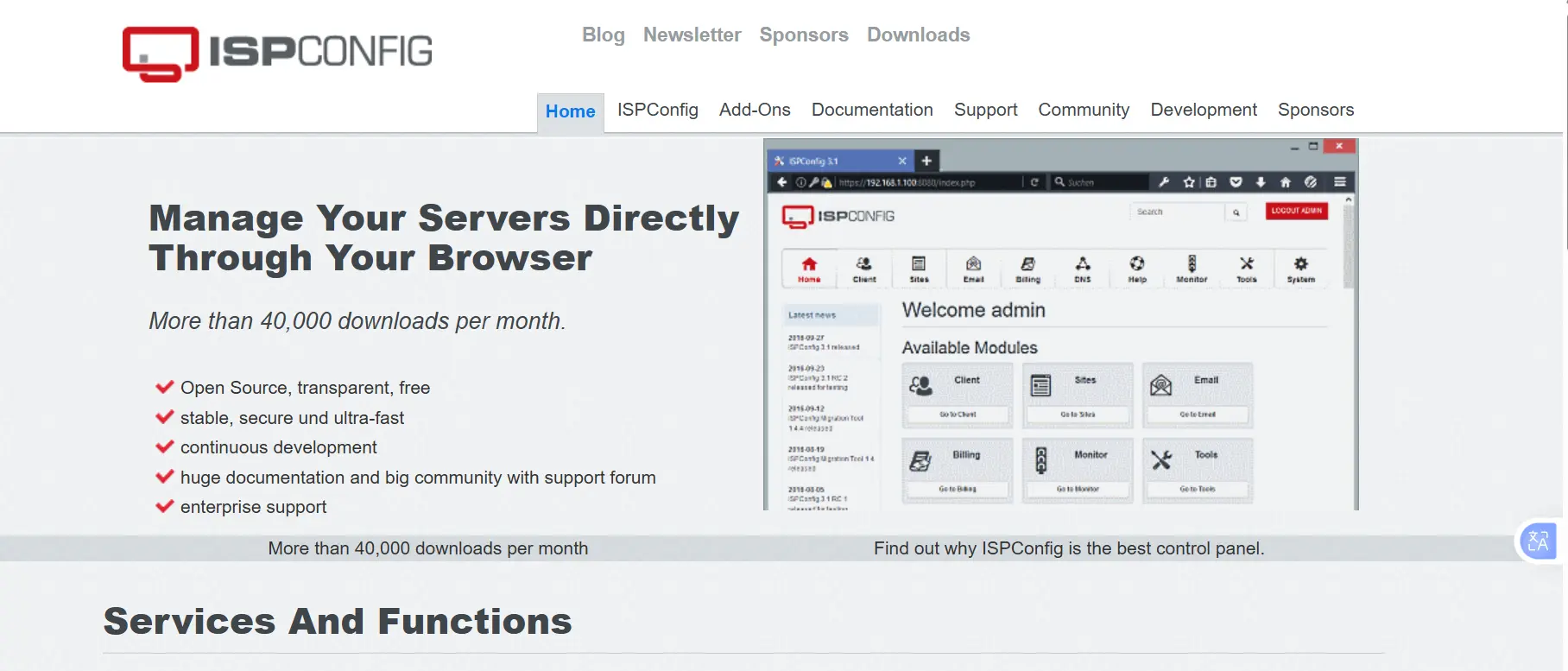
ISPConfig is a mature, free, open-source panel with strong reseller-account support and genuine multi-server capability, managing websites, email, DNS, databases, and more from a central interface.
Features:
- Reseller and client account management
- Custom hosting packages and resource limits
- DNS, email, and database management
- SSL support
- Multi-server management
Pricing: Completely free and open source, no licensing fees at any scale.
Pros: Zero licensing cost, highly configurable, strong multi-server capabilities, and a good fit for larger infrastructures.
Cons: Steeper learning curve and a less polished, less beginner-friendly interface than commercial panels.
Best for: Experienced hosting operators who need multi-server management, deep customization, and no recurring license fees.
6) InterWorx
InterWorx is a commercial panel built specifically for hosting providers, with a strong emphasis on multi-tenancy, account isolation, automation, and clustering across its two-part NodeWorx (server) / SiteWorx (client) architecture.
Features:
- Reseller accounts for managing customer websites
- Custom hosting packages and resource limits
- Customer management tools
- API and CLI tools for automation
- Clustering for managing multiple servers
- NodeWorx for server administration
- SiteWorx for managing individual websites
Pricing: InterWorx licenses per server with unlimited accounts included, rather than charging per account; entry-level VPS licenses start around $7.50/month for servers with 4 or fewer vCPUs, with a Single Server License around $20/month, and some resellers list starting prices closer to $10/month depending on the package.
Because InterWorx doesn’t charge more as your account count grows, and because it distributes services across multiple servers with built-in load balancing (something cPanel only supports for DNS and remote database servers), it holds a real cost and architecture advantage at scale.
It also supports multiple administrator accounts with granular permissions, unlike cPanel’s single root-only admin model.
Pros: Strong account isolation, native clustering, automation, and a feature set built specifically around hosting-provider workflows.
Cons: Smaller market share and ecosystem than cPanel or Plesk, with less widely available third-party documentation and community support.
Best for: High-volume resellers and hosting providers who need clustering, automation, and predictable per-server (not per-account) commercial pricing.
7) CloudPanel

CloudPanel is a free, lightweight panel built for modern cloud and VPS environments rather than for replicating every traditional shared-hosting feature.
Features:
- Nginx-based hosting for reliable website performance
- PHP support for dynamic websites and applications
- Database management for websites and web apps
- SSL certificates for secure connections
- Backup tools for protecting website data
- Git integration for managing and deploying code
- Cloud and VPS management tools for greater server control
Pricing: Free.
Pros: Lightweight, modern interface, fast deployment, and low resource overhead.
Cons: Limited traditional reseller and email-hosting features compared with full WHM alternatives; it’s built more for application hosting than classic shared-hosting resale.
Best for: Developers and modern hosting businesses managing cloud applications or VPS-based sites rather than traditional shared-hosting accounts.
Choosing the Right Fit
There is no single WHM alternative that works for every reseller. The right choice depends on your budget, technical needs, and how you manage client accounts.
If predictable pricing is important, DirectAdmin and InterWorx use per-server pricing instead of cPanel’s per-account model. If you want a free, open-source option and are comfortable with a steeper learning curve, HestiaCP and ISPConfig are worth considering. CyberPanel may suit resellers who mainly host WordPress websites.
Plesk can be a good option if you need Windows support or access to a large extensions marketplace. CloudPanel is more focused on cloud and application-based hosting rather than traditional shared hosting.
Prices and licensing can change, so check the latest rates with each provider before switching.
The control panel is only part of the setup. Your hosting infrastructure, server resources, support, and reseller features also count. If you’re moving away from WHM, choose a reseller hosting plan that works well with your preferred control panel.
You can check Truehost’s reseller hosting plans to see the available options.