 Domain SearchInstantly check and register your perfect .pk or international domain
 Web HostingGet a .pk domain for as low as PKR 467
 cPanel HostingUser-friendly hosting powered by cPanel
 Reseller HostingLaunch your own hosting business with minimal technical requirements
 Windows HostingOptimized for Windows-based applications and websites
 Affiliate ProgramEarn referral commissions by promoting our services
 WordPress HostingFast & Reliable WordPress Hosting
 Domain TransferMigrate your existing domain seamlessly with zero downtime.
 All DomainsAccess 324+ top-level domains (TLDs) worldwide from a single platform
 Whois LookupIdentify the owner of any domain using our whois and rdap lookup tool
 Managed VPS Hosting
 AI Website BuilderCreate beautiful websites effortlessly using intuitive drag-and-drop features
 Online ShopLaunch a professional online shop with no technical skills required
 BlogDiscover expert guides on hosting, websites, SEO, and digital growth strategies
 ContactGet instant assistance via live chat or email
 SupportAccess help articles, tutorials, and service documentation
 SSL CertificatesEncrypt data, build trust, and boost SEO.
Every website starts somewhere, and for many businesses, that means shared hosting. It is affordable, easy to use, and usually enough for a new blog or small business website. But as a website grows, shared hosting can become limiting.
More visitors, more products, or a growing application can lead to slower loading times, performance issues during traffic spikes, and less control over the server. This is where managed VPS hosting can help.
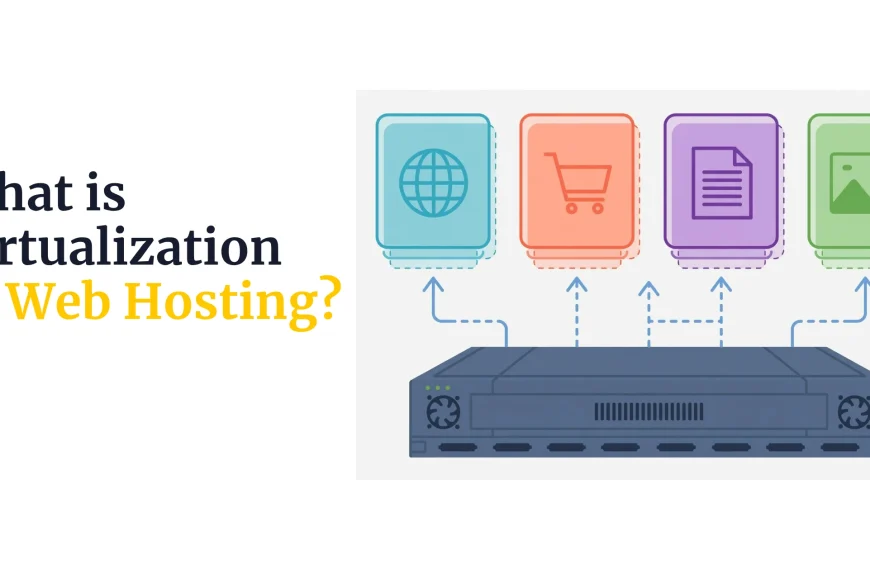
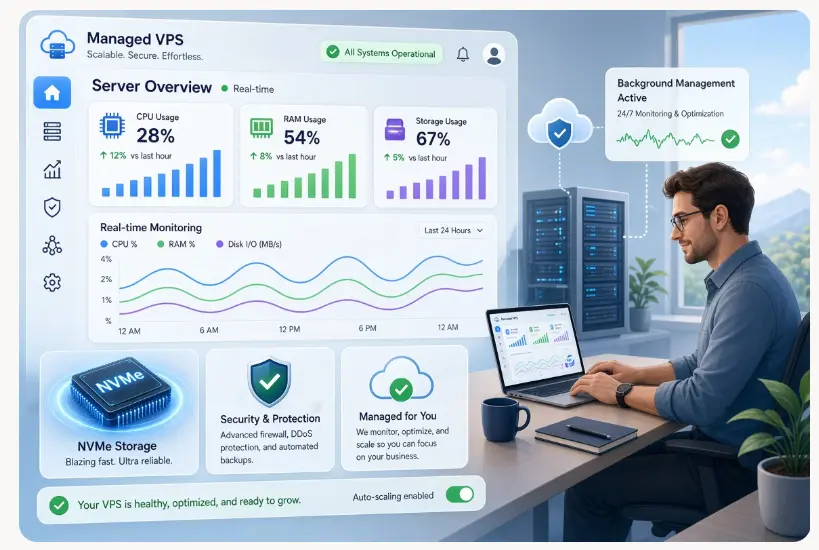
A managed VPS gives your website or application its own share of server resources, including CPU, RAM, and storage, with more isolation than shared hosting. The hosting provider also handles much of the technical work, such as server updates, security patches, monitoring, backups, and technical support.
Unlike an unmanaged VPS, where you handle these tasks yourself, a managed VPS lets you focus on your website or application while the hosting provider takes care of the server.
This makes VPS hosting a common step between shared hosting and a dedicated server for businesses that have outgrown shared hosting but do not need an entire physical server.
Key Benefits of Managed VPS Hosting
1) Better Performance
On shared hosting, your site’s performance can be affected by what other websites on the same server are doing; a traffic spike on someone else’s site can slow yours down. A VPS changes that dynamic:
- Your VPS has its own allocated resources (CPU, RAM, storage) that aren’t pooled with other accounts.
- Other websites on the same physical machine are far less likely to affect your performance, since resources are isolated at the virtualization layer.
- A VPS can handle significantly more traffic and more concurrent visitors than a typical shared hosting plan.
- Providers typically monitor server health around the clock and respond when something looks off, often before it becomes a visible problem for visitors.
This counts more than it might seem: with many users expecting websites to load quickly, performance issues can lead to lost visitors and abandoned carts. Google’s PageSpeed Insights provides tools for measuring website performance and Core Web Vitals.
2) Better Security
Security is one of the most commonly cited reasons businesses upgrade from shared to managed VPS hosting:
- The provider handles server-level updates and security patches, closing vulnerabilities before they can be exploited.
- Your VPS environment is isolated from other customers, so a security issue on someone else’s account is far less likely to spill over into yours.
- Managed plans commonly include firewalls, malware scanning, and DDoS (Distributed Denial-of-Service) protection as standard features.
- Some providers also assist with compliance requirements, for example, configurations that support PCI DSS for e-commerce or HIPAA for healthcare-adjacent applications.
Because so much of the modern web now runs over HTTPS by default, and because attacks increasingly target infrastructure rather than just individual sites, having a provider actively managing your server’s security posture is a meaningful advantage over a self-managed or shared setup.
3) Easy to Scale
Growth shouldn’t mean starting over on a new hosting plan every few months. VPS hosting is built around the idea of scaling in place:
- You can increase CPU, RAM, or storage as your needs grow, often without migrating to new infrastructure.
- You have far more control over server configuration than shared hosting allows: custom software, specific runtime versions, and tailored server rules.
- You can install applications, extensions, or tools that shared hosting environments typically restrict or don’t support at all.
- You can grow substantially before you’d ever need to move to a full dedicated server , which makes VPS a natural mid-point for businesses on a growth trajectory.
4) Less Server Work for You
The “managed” part of managed VPS is where a lot of its value lives, especially for teams without in-house infrastructure expertise:
- The provider handles routine tasks such as software updates, system monitoring, and general maintenance.
- Support is available when server-level problems occur, rather than leaving you to diagnose issues alone.
- You spend measurably less time on the technical side of keeping a server running.
- That time gets reinvested into the business itself, building products, serving customers, or growing revenue, instead of patching servers at midnight.
5) Good Value for Growing Businesses
Managed VPS occupies a useful middle ground on cost:
- It costs more than basic shared hosting, which is expected given the dedicated resources and active management involved.
- It typically costs meaningfully less than hiring a dedicated systems administrator or DevOps engineer to manage a server in-house.
- For businesses that need more power and reliability than shared hosting can offer but don’t have (or want) a technical team, it’s often the most cost-effective path forward.
6) Modern Technology
Hosting infrastructure has evolved considerably, and many current managed VPS plans include:
- NVMe storage, which offers substantially faster read/write speeds than older SSD or HDD storage, a direct benefit for database-heavy sites and applications.
- Automated monitoring that flags issues (resource spikes, downtime, suspicious traffic) before they escalate.
- Optimized server software tuned for popular platforms like WordPress and WooCommerce, improving load times and stability out of the box.
Together, these technologies mean a modern managed VPS plan often performs closer to a dedicated server than older-generation VPS offerings did just a few years ago.
Common Use Cases for Managed VPS Hosting
a) Growing Websites and Blogs
Managed VPS is a natural fit for sites that have outgrown shared hosting: growing traffic, more frequent slowdowns during spikes (a viral post, a seasonal surge), or simply the need for more consistent performance as an audience builds.
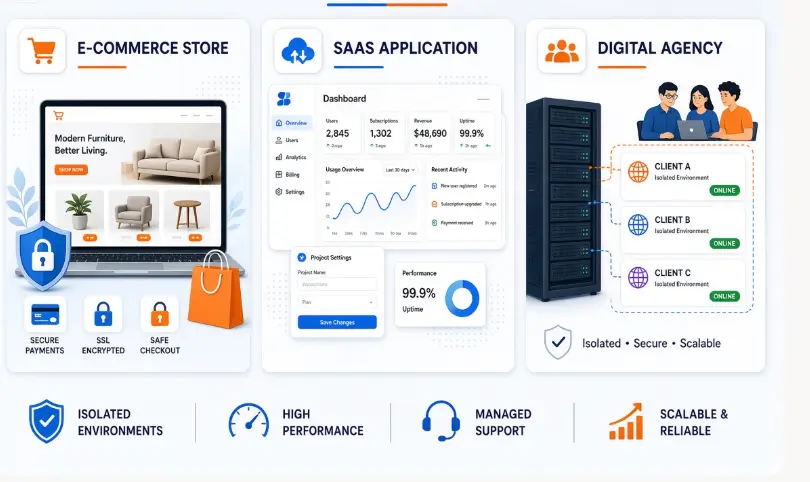
b) E-Commerce Stores
Online stores running on platforms like WooCommerce or Magento benefit from:
- Stronger, more consistent performance under load
- More server resources for product catalogs, checkout processes, and plugins
- Regular, automated backups to protect transaction and inventory data
- Stronger security to protect customer payment information
- Reliable handling of high-traffic periods like holiday sales or promotional events, when downtime or slow checkout pages directly cost revenue
c) SaaS and Web Applications
For software-as-a-service products and custom web applications, managed VPS offers:
- Dedicated server resources that don’t fluctuate based on other tenants
- Greater control over the hosting environment, runtime versions, dependencies, and configurations
- Reduced server maintenance burden for developers, who can focus on product development instead of infrastructure upkeep
d) Agencies Managing Multiple Websites
Digital agencies hosting several client sites can use a single VPS (or a set of VPS instances) to get:
- Better resource allocation across client projects
- Stronger isolation between sites, so one client’s traffic spike or issue doesn’t affect another’s
- Professional-grade server support from the hosting provider
- Lower ongoing maintenance overhead compared to managing each site’s infrastructure separately
e) Business Applications
Beyond public-facing websites, managed VPS is commonly used to host internal and customer-facing business tools, including:
- CRM systems
- Customer portals
- Databases
- Internal business tools and dashboards
- Content management systems
f) Businesses With Small Technical Teams
Small businesses and startups often need more computing power and reliability than shared hosting provides, but don’t have the staff to manage a server themselves. Managed VPS bridges that gap: the provider handles the bulk of server maintenance, while the business gets dedicated-server-level benefits without needing to hire for it.
g) Development and Testing
Managed VPS is also a practical environment for:
- Testing websites and applications before public release
- Staging sites ahead of launch, in an environment that mirrors production
- Running custom software that shared hosting environments don’t support
- Configuring specific server setups (particular software versions, custom rules, or unique architectures) that development work often requires
Is Managed VPS Hosting Right for You?
Managed VPS hosting tends to make the most sense once a business has outgrown the constraints of shared hosting but doesn’t yet need, or want to pay for, a full dedicated server. If any of the following sound familiar, it’s worth evaluating:
- Your site is slowing down during traffic spikes, or performance has become inconsistent
- You’re running an online store and need stronger security, backups, and uptime
- You’re building or scaling a SaaS product or custom application
- You manage hosting for multiple client websites
- You need more server control (custom software, specific configurations) than shared hosting allows
- You want the benefits of a private server without hiring dedicated technical staff
For businesses in any of these positions, managed VPS hosting offers a practical, cost-effective way to get more performance, security, and control, while leaving the day-to-day server administration to the people who do it professionally. If your website or application is ready for more power, security, and reliability, a managed VPS plan gives you the resources of a private server with the support of a dedicated team behind it, so you can focus on growing your business instead of managing infrastructure.