 Domain SearchInstantly check and register your perfect .pk or international domain
 Web HostingGet a .pk domain for as low as PKR 467
 cPanel HostingUser-friendly hosting powered by cPanel
 Reseller HostingLaunch your own hosting business with minimal technical requirements
 Windows HostingOptimized for Windows-based applications and websites
 Affiliate ProgramEarn referral commissions by promoting our services
 WordPress HostingFast & Reliable WordPress Hosting
 Domain TransferMigrate your existing domain seamlessly with zero downtime.
 All DomainsAccess 324+ top-level domains (TLDs) worldwide from a single platform
 Whois LookupIdentify the owner of any domain using our whois and rdap lookup tool
 Managed VPS Hosting
 AI Website BuilderCreate beautiful websites effortlessly using intuitive drag-and-drop features
 Online ShopLaunch a professional online shop with no technical skills required
 BlogDiscover expert guides on hosting, websites, SEO, and digital growth strategies
 ContactGet instant assistance via live chat or email
 SupportAccess help articles, tutorials, and service documentation
 SSL CertificatesEncrypt data, build trust, and boost SEO.
You have been staring at a domain search bar for the last ten minutes.
The name is perfect. You finally landed on it.
Then the results load, and there it is: both .org and .net are available. Which one should you choose?
Both can work. The better choice depends on what your website represents and the impression you want to create.
.org comes from organization and was originally intended for nonprofits, associations, and other non-commercial groups.
.net comes from network and was originally created for internet infrastructure and networking companies.
Today, neither extension is limited to its original purpose. Businesses, startups, personal projects, and organisations use both.
Still, those original meanings can shape visitor expectations. A .org domain may suggest a mission, community, or cause, while a .net domain may feel more technical or connected to digital services.
That makes your choice more than just picking what is available. Your domain extension becomes part of your brand and appears on your website, business cards, email addresses, and search results.
Take the same name:
truehostpk.orgfeels more like an organisation or initiative.truehostpk.netfeels more like a platform or technology service.
Same name, different first impression. The best choice is the one that matches what your website actually represents.
Already have a name in mind? Check .org and .net availability and pricing before you commit.
In this guide, we’ll compare .org vs .net across branding, SEO, pricing, use cases, and registration to help you choose the right extension.
.org vs .net: How Are They Different?
The quick version, before we go deeper:
| Feature | .org | .net |
|---|---|---|
| Traditional association | Organizations | Networks |
| Common modern use | Nonprofits, communities, organizations | Technology, online services, digital businesses |
| Business use | Yes | Yes |
| SEO advantage | No inherent advantage | No inherent advantage |
| Brand perception | Organization-focused | Technical/digital |
| Alternative to .com | Yes | Yes |
Original purpose aside, both extensions function identically from a technical standpoint. Modern usage has stretched both well past their original definitions. Brand perception still leans in different directions, though, and that’s where the real decision lives.
Audience expectations shift depending on which one you pick. Availability tends to favor whichever one is less commonly grabbed for your specific niche. And website suitability really comes down to what your site actually does, not what the extension technically allows.
The takeaway, before we go further: neither extension is universally better. The right choice depends on your website and your brand.
When Does a .org Domain Make Sense?
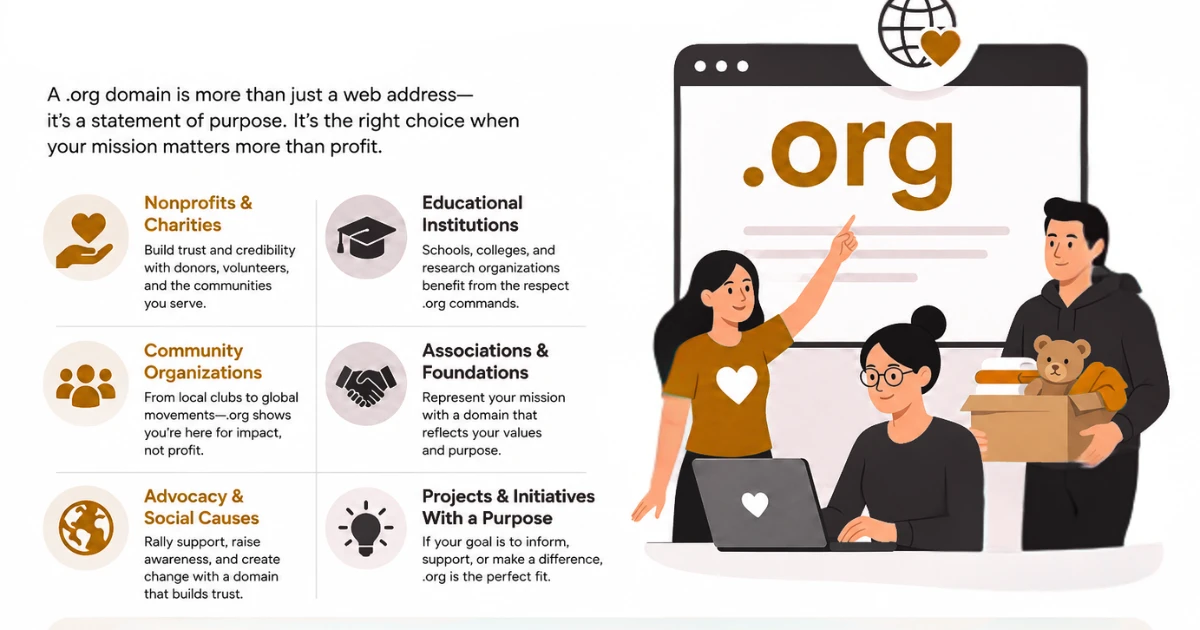
.org fits naturally when your website represents a mission, a cause, or a group rather than a straightforward commercial transaction. More than 12 million .org domains are registered worldwide, run by a nonprofit registry built specifically to support mission-driven organizations. If that sounds like you, check .org availability and pricing before you settle on anything else.
That includes:
- Nonprofits
- Charities
- Community groups
- Educational initiatives
- Professional associations
- Open-source projects
- Public-interest projects
- Membership organizations
The branding benefits are real..org carries familiarity built over decades. It signals a mission-driven perception before a visitor reads a single word of your homepage. It creates an immediate community association, and it matches what audiences already expect from an organizational identity.
Commercial businesses can absolutely use .org. Nothing technically stops you. But ask yourself honestly: does .org accurately represent what your business actually is? If you are selling a product for profit, a .org address can occasionally create a mismatch between what visitors expect and what they actually find.
When Does a .net Domain Make Sense?
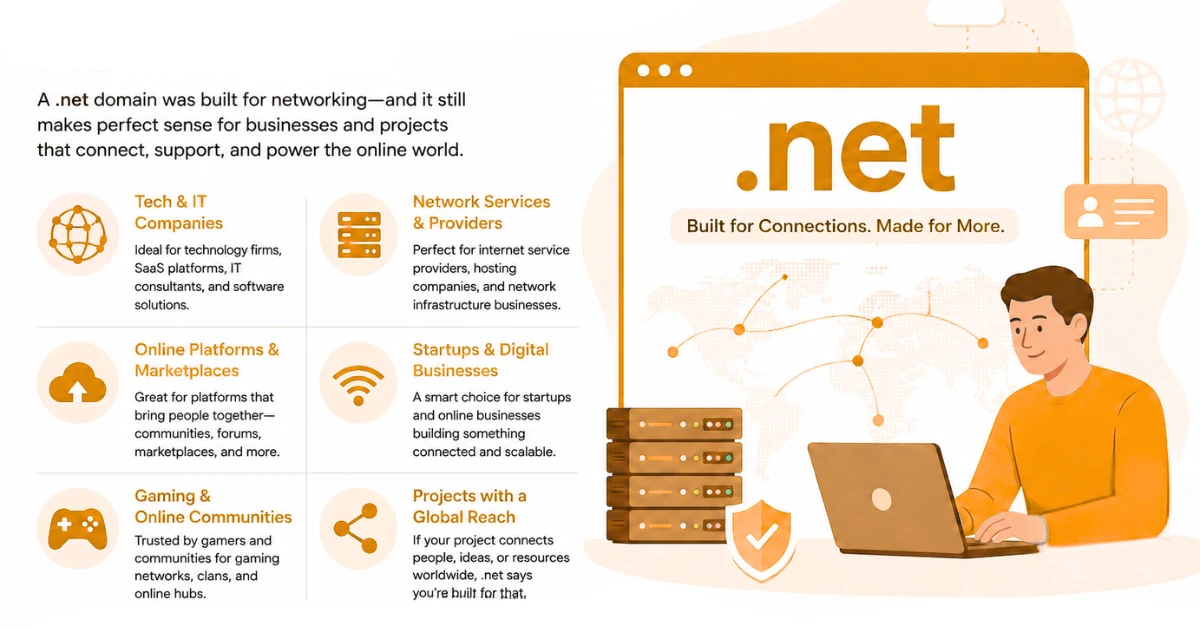
.net fits naturally for anything technical, digital, or infrastructure-related. If that’s closer to your project, see .net availability and pricing while your first-choice name is still up for grabs.
That includes:
- Technology companies
- Networking businesses
- SaaS platforms
- Hosting companies
- Internet services
- Online tools
- Digital platforms
- Technology startups
The associations line up cleanly: technology, digital services, connectivity, online platforms, technical expertise. A visitor seeing a .net domain doesn’t blink twice if the site turns out to be a SaaS tool or a hosting company. net now has over 12 million registered domains worldwide, making it one of the most established alternatives to .com.
.net isn’t limited to tech businesses, though. It’s also one of the most common fallback choices when a preferred .com is already taken. If your business name is solid but the .com is gone, .net is often the more natural next pick over a less recognizable extension.
A software consultancy called BrightPath, for example, loses very little by settling for BrightPath.net if BrightPath.com is unavailable. The extension still reads as credible and current, which isn’t always true of less familiar alternatives.
.org vs .net for Branding: What Will Your Audience Think?
Your domain extension is part of your brand experience, whether you planned it that way or not.
What .org can communicate:
- Organization
- Community
- Mission
- Public interest
- Nonprofit identity
What .net can communicate:
- Technology
- Digital services
- Connectivity
- Online platforms
- Technical expertise
Before you decide, ask yourself a few honest questions. What does your website actually do? Who is your audience, and what do they expect to see? What impression should your domain create in the first two seconds? And does the extension actually sound natural next to your brand name, or does it feel forced?
Credibility doesn’t come from the extension alone. It comes from the whole package: your content, your security, your design, and how the site actually performs once someone lands on it. The extension sets an expectation. Everything else has to deliver on it.
Does .org or .net Affect SEO?
Short answer: no, not directly.
Neither .org nor .net carries an inherent ranking advantage over the other. Google doesn’t boost .org sites for looking trustworthy, and it doesn’t penalize .net sites for sounding technical.
What actually moves the needle for SEO:
- Search intent match
- Genuinely helpful content
- Technical SEO fundamentals
- Website speed
- Mobile experience
- Internal linking
- Backlinks
- Overall website authority
- Content relevance
- User experience
None of that cares which extension sits at the end of your domain. A well-built .net site will consistently outrank a poorly built .org site, and vice versa.
The takeaway: choose the extension that fits your brand, not because you expect it to hand you an SEO shortcut. It won’t.
What If Your Preferred .org or .net Domain Is Taken?
This happens constantly, and it’s rarely the end of the road. Run a quick domain search to see instantly which variations are actually open before you settle on anything.
Start here:
- Check whether the alternative extension (
.orgif.netis gone, or vice versa) is available. - Try a simple, natural brand variation.
- Add a relevant word that still fits your brand.
- Consider a shorter version of your name.
- Add a location or service term where it makes sense.
- Check how the existing domain is actually being used, since an inactive one might be worth an offer.
- Avoid anything confusingly similar to an existing brand.
What to avoid entirely: complicated spellings, excessive numbers, unnecessary hyphens, or copying a name close enough to someone else’s brand that it creates confusion.
A memorable alternative beats an awkward, forced version of your first choice every time. If people can’t remember or spell it, the name isn’t actually working for you, however perfect it looked on paper.
How Much Do .org and .net Domains Cost?
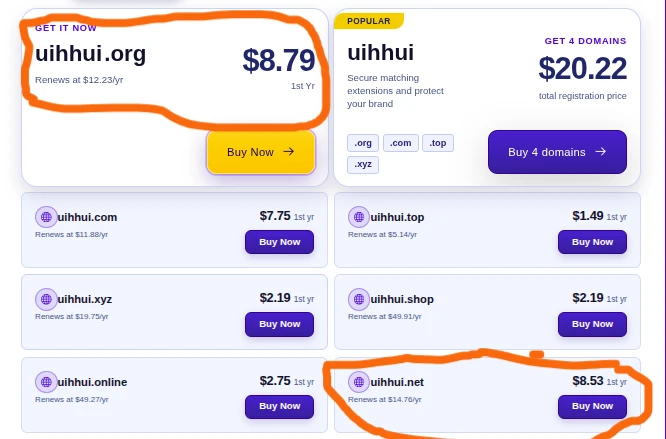
Pricing varies by registrar, and it changes over time, so treat any number you see as a snapshot rather than a permanent fact.
What actually makes up the cost:
- Registration price (often discounted for the first year)
- Renewal price (usually the real, ongoing cost)
- Transfer fees, if you ever move registrars
- Optional add-ons like WHOIS privacy
- Domain management features included or charged separately
The trap: registrars love advertising a low first-year price. The renewal price, quietly listed further down the page, is often noticeably higher. Don’t choose based on that first-year number alone.
Compare the total cost of ownership instead, especially if you plan to hold onto the domain for several years, which most serious websites do. Truehost PK’s domain pricing shows both registration and renewal rates upfront, so you’re not hunting for the real cost.
.org vs .net: Pros and Cons at a Glance
.org
Pros:
- Strong organization association
- Familiar for nonprofits and communities
- Good fit for mission-driven brands
- Recognizable worldwide
Cons:
- Can create nonprofit or organization expectations
- May not feel natural for every commercial business
.net
Pros:
- Strong digital and technology association
- Recognizable worldwide
- Suitable for online services
- Useful alternative when .com is gone
Cons:
- May not communicate a mission or organization clearly
- Can feel less natural for community or nonprofit projects
How Do You Decide Between .org and .net?
Step 1: Define your website.
What does it actually represent, beyond just what it sells or offers?
Step 2: Identify your audience.
What will they expect the moment they see your domain in a search result or a link?
Step 3: Say the domain out loud.
Is it easy to pronounce? Easy to spell? Memorable? Does it sound natural with the extension attached, or awkward?
Step 4: Compare both versions.
Weigh brand fit, memorability, availability, cost, and long-term usefulness side by side.
Step 5: Think beyond today.
Will this domain still make sense if your brand grows, pivots, or expands into new offerings? A name that fits perfectly today but boxes you in later isn’t actually the safe choice.
.org vs .net: Which One Should You Pick?
| Website Type | Better Fit |
|---|---|
| Nonprofit | .org |
| Charity | .org |
| Community organization | .org |
| Educational initiative | .org |
| Open-source project | .org |
| Professional association | .org |
| Technology company | .net |
| Networking service | .net |
| SaaS platform | .net |
| Online service | .net |
| Technology startup | .net |
| General business | Either |
| Personal project | Either |
The simple rule: choose .org when the domain should reinforce an organization, community, or mission. Choose .net when the domain naturally supports a technology, network, or online-service identity. If both genuinely work for your brand, pick whichever is easier to remember and stronger for how you want to be perceived.
Should You Register Both .org and .net?
Sometimes, yes. Sometimes, it’s overkill.
Register both when:
- You want to protect your brand from copycats or confusion
- Both are actually affordable for your budget
- You want to prevent a competitor or squatter from grabbing the other
- You plan to redirect one to the other anyway
- Your brand already has real, established value worth protecting
One domain may be enough when:
- Your budget is tight and every dollar matters
- One extension clearly and obviously fits your brand
- There’s little realistic risk of confusion
- The second domain would serve no actual practical purpose
The goal was never to collect extensions like trophies. It’s to protect and build the one brand people actually know you by.
Common Domain Extension Mistakes to Avoid
- Choosing an extension because of an SEO myth rather than an actual advantage.
- Picking
.orgpurely because it sounds trustworthy, without checking brand fit. - Choosing
.netwithout considering whether it actually matches your business. - Looking only at the first-year price and ignoring renewal costs.
- Going with a complicated, hard-to-spell domain name.
- Adding unnecessary numbers or hyphens to force availability.
- Ignoring similar existing businesses that could create confusion.
- Registering multiple extensions with no real plan for using them.
- Choosing a domain so specific it limits where your brand can grow.
FAQs
Can I use a .org or .net domain for a professional email address?
Yes. Both extensions support custom email addresses like [email protected] or [email protected], just like .com does.
Can I transfer a .org or .net domain to another registrar?
Yes, as long as the domain has passed its initial 60-day lock period and you have your EPP/auth code from your current registrar.
How long can I register a .org or .net domain for?
Most registrars, including Truehost PK, let you register for one year at a time or lock in multiple years upfront, often up to ten.
Can I sell my .org or .net domain to someone else?
Yes. Domain names can be sold or transferred to a new owner at any time, though the process involves updating ownership details with your registrar.
What happens when a .org or .net domain expires?
There’s typically a grace period to renew before the domain enters a redemption phase with added fees, and eventually becomes available for anyone else to register.
Can I use a .org or .net domain with WordPress?
Yes. WordPress works identically regardless of which extension you choose, so this decision has zero impact on your platform options.
How to Register a .org or .net Domain
Step 1: Choose your domain name.
Keep it short, relevant, memorable, and easy to spell.
Step 2: Search for availability.
Check whether your preferred .org or .net domain is actually open.
Step 3: Compare your options.
If your first choice is gone, weigh the other extension or a clean variation.
Step 4: Review the price.
Check both the registration rate and, just as importantly, the renewal rate.
Step 5: Register the domain.
Complete checkout and lock in your name before someone else does.
Step 6: Connect it to your hosting.
Point the domain to your hosting account and start building.
Found the domain you want? Don’t leave it sitting in your search results while you think it over.
Search for your preferred .org or .net domain with Truehost PK and secure your name before someone else does.