 Domain SearchInstantly check and register your perfect .pk or international domain
 Web HostingGet a .pk domain for as low as PKR 467
 cPanel HostingUser-friendly hosting powered by cPanel
 Reseller HostingLaunch your own hosting business with minimal technical requirements
 Windows HostingOptimized for Windows-based applications and websites
 Affiliate ProgramEarn referral commissions by promoting our services
 WordPress HostingFast & Reliable WordPress Hosting
 Domain TransferMigrate your existing domain seamlessly with zero downtime.
 All DomainsAccess 324+ top-level domains (TLDs) worldwide from a single platform
 Whois LookupIdentify the owner of any domain using our whois and rdap lookup tool
 Managed VPS Hosting
 AI Website BuilderCreate beautiful websites effortlessly using intuitive drag-and-drop features
 Online ShopLaunch a professional online shop with no technical skills required
 BlogDiscover expert guides on hosting, websites, SEO, and digital growth strategies
 ContactGet instant assistance via live chat or email
 SupportAccess help articles, tutorials, and service documentation
 SSL CertificatesEncrypt data, build trust, and boost SEO.
When a domain name expires, your website goes offline, your business email stops working, and customers are no longer able to find you online, sometimes within hours.
That’s not a worst-case scenario. It’s just what happens by default, and it happens to businesses in Pakistan every single day.
In most cases when you already have your domain, you don’t think about expiry all the time. I mean, it’s a whole year or several until it expires. But soon enough that period elapses, and some people don’t remember until it’s already too late.
The good news is, there’s a clear window to act at every stage. The bad news is that the window gets smaller and more expensive the longer you wait.
Let’s see what happens after a domain expires and what you can do at each stage to keep your domain.
Series of Events from When a Domain Name Expires
1) Your Domain Expires And Everything Stops
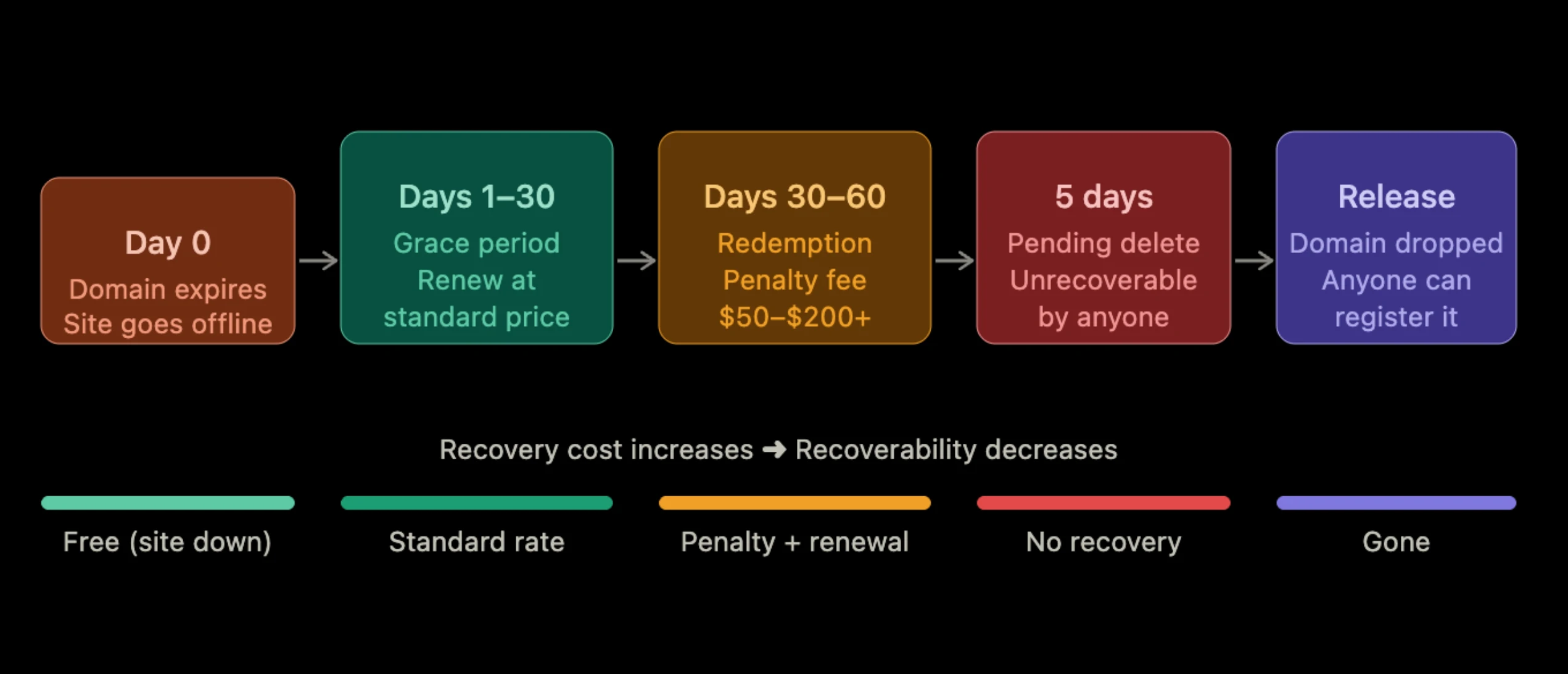
This marks the moment of expiry on day 0.
Once your domain reaches its expiry date, your registrar may suspend the domain. Your website stops loading, and email addresses linked to the domain stop working.
That can affect much more than your homepage.
If your business uses yourbrand.pk for customer emails, Google Workspace, payment systems, business profiles, or other online services, those services may also be affected.
Someone trying to email [email protected], for example, will receive a delivery failure instead.
For a Pakistani business, losing access to a familiar .pk or .com.pk address can also create confusion. A customer who has always visited your website at the same address will suddenly see an error or an expired-domain page instead.
The domain is also placed in a restricted status, so you cannot simply transfer it to another registrar or make normal domain changes until you renew or recover it.
The important thing here is to not wait for your website to go down before checking your renewal status.
2) The Grace Period
Here, you still have time on days 1-30 (recoverable, at standard cost).
For many generic domain extensions, the period immediately after expiry gives the original registrant an opportunity to renew the domain before it moves further through the deletion process.
The length and conditions of this period depend on the domain extension and registrar. A 30-day period is common for many generic TLDs, but you shouldn’t assume that every domain follows the same timetable.
If your domain is still in the registrar’s renewal window, renewing it is usually the simplest and least expensive way to get it back.
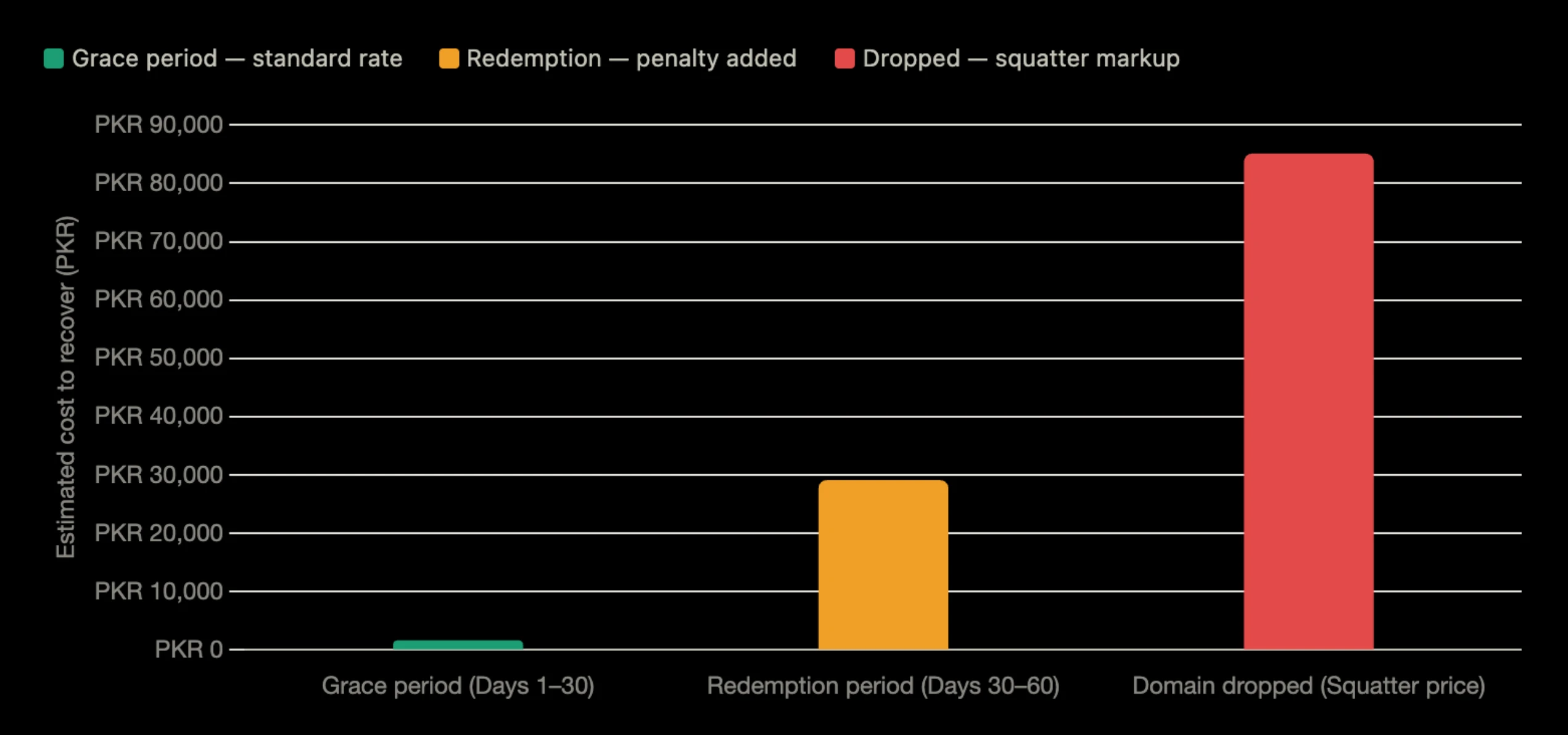
At Truehost, our renewal pricing is displayed clearly so you can see what you’ll pay for your domain. For example:
.pkrenewal: ₨19,785.50/year.com.pkrenewal: ₨5,653.00/year
Your domain may remain unavailable to visitors while it is expired, even though you can still renew it. Once the renewal is processed, your website and email can start working again as the domain’s DNS information becomes available across the internet.
For generic TLDs, ICANN’s expired-domain policies provide specific recovery rights during the applicable renewal and redemption stages.
For a .pk domain, PKNIC states that an unpaid domain can be deactivated and then held for two weeks, during which the domain owner can pay and reactivate it.
3) The Redemption Period
Expensive, but not too late on days 30–60 (recoverable, at penalty cost).
For many generic TLDs, missing the initial renewal window can move the domain into the Redemption Grace Period.
This is still a recovery stage, but it is much less convenient than ordinary renewal. Under ICANN’s standard redemption process, a domain can remain in redemption for 30 days, during which the original registrant can ask the sponsoring registrar to restore it.
A redemption recovery normally involves:
- Paying the domain’s renewal fee
- Paying an additional redemption or restoration fee
- Restoring the domain through the current registrar
- Waiting for the domain to become active again
The additional fee varies by registrar and domain extension, so there isn’t one universal redemption price. Some registrars may charge the equivalent of tens or hundreds of US dollars on top of the normal renewal fee.
During redemption, the domain is removed from the active DNS and cannot be used normally.
ICANN’s EPP status guidance also indicates that the domain cannot simply be modified or transferred during this stage; the registrant needs to work with the sponsoring registrar to restore it.
This generic ICANN timeline should not be applied directly to .pk domains. PKNIC has its own policy.
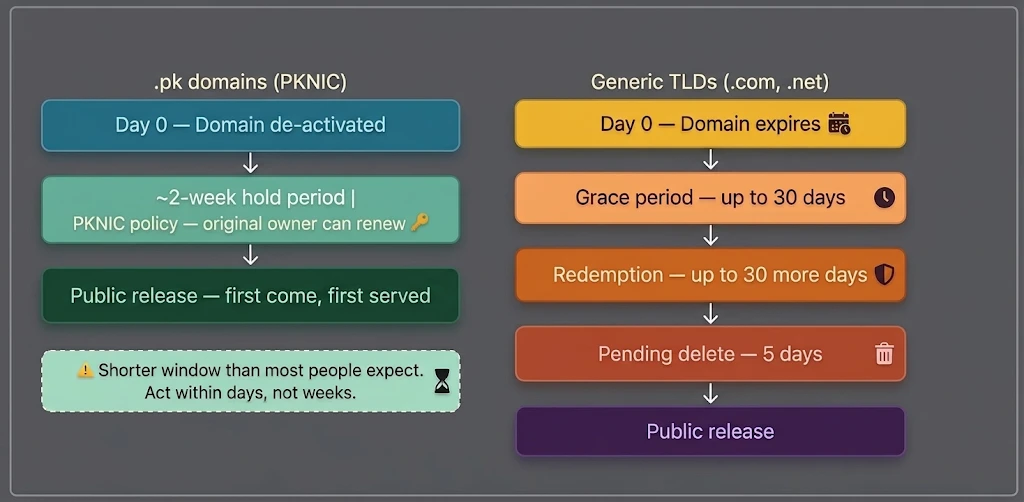
Its current policy says that when the maintenance fee is not paid by the due date, PKNIC can deactivate the domain and offer it to a third party after a two-week hold period. The original owner can pay and reactivate the domain during that hold period.
So if you own a .pk, .com.pk, or another PKNIC-managed domain, consider this.
4) Pending Delete
The point of no return for 5 days (unrecoverable).
For many generic TLDs, a domain that is not restored during redemption enters Pending Delete.
This stage lasts five days under the standard ICANN registry lifecycle. Once a domain reaches Pending Delete, it cannot be renewed or restored through the normal registrar process.
The domain is essentially waiting to be removed from the registry.
For a business, this is a serious point in the process. Your website is already unavailable, email linked to the domain is affected, and customers may be looking for alternatives.
Your domain may also attract people who monitor expired domains. Valuable names can be picked up quickly after release, especially if they have an established brand name, useful keywords, backlinks, or existing traffic.
For .pk domains, don’t assume there will be a five-day Pending Delete stage, especially with the PKNIC’s published policy that uses a different process..
5) The Domain Drops
Anyone can take it (public release).
Once a generic domain completes its deletion process, it returns to the registry’s available pool. At that point, someone else can register it. That person could be another business, a domain investor, a competitor, or someone who sees an opportunity to resell the name.
If your old domain had built up recognition or search traffic, getting the name back may be difficult. Someone else could register it before you get another chance.
For .pk domains, PKNIC’s policy says an unpaid domain can be offered to a third party for re-registration after the two-week hold period, on a first-come, first-served basis.
So if your former .pk domain becomes available again, don’t leave it sitting there. Check its availability and register it if it is still free.
The cost of losing a domain goes beyond paying for another registration.
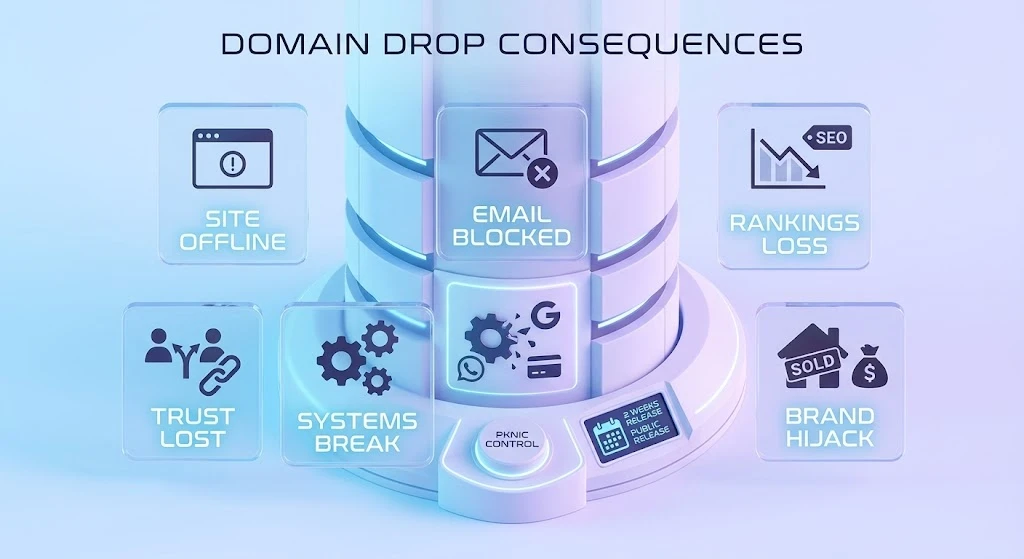
- Your website: Visitors can no longer reach the site at your old address.
- Your email: Messages sent to your old domain-based addresses may no longer reach you.
- Your brand: Someone else may register the name and use an address customers associate with your business.
- Your search visibility: Moving to a completely different domain means rebuilding your website’s search presence and redirects from scratch.
- Your integrations: Services connected to the old domain may require updates or verification again.
The registration fee may be the smallest part of the problem.
How to Make Sure Your Domain Never Expires
The easiest way to deal with domain expiry is to prevent it from happening in the first place.
1. Enable auto-renewal at your registrar.
Truehost supports auto-renewal, so you can have your domain renewed automatically instead of relying entirely on memory. Check that the feature is enabled for your domain.
2. Keep your payment method updated and linked.
Auto-renewal won’t help if your payment method has expired, has insufficient funds, or is no longer valid. Keep your preferred payment method current and check your account before the renewal date.
3. Set a calendar reminder 60 days before expiry as a backup.
Even with auto-renewal enabled, a second reminder is useful. Sixty days gives you plenty of time to fix a failed payment, update account details, or contact your registrar if something looks wrong.
4. Register for 2–3 years at a time to reduce annual renewal risk.
If you know you’ll keep the domain for several years, registering it for a longer period means fewer yearly renewal dates to remember. It can be a simple way to reduce the chance of an accidental expiry.
5. Consider registering both .pk and .com.pk to protect your brand across variants.
If your business uses yourbrand.pk, registering yourbrand.com.pk as well can help protect the name from being used by someone else. The same applies in reverse.
6. Keep your registrar contact email current.
Your registrar needs a working email address to send renewal reminders and account notifications. If you’ve stopped using the email address on your account, update it before your next renewal date.
Register or Renew Your Domain with Truehost Today
A domain expiry can start with something as small as a missed renewal email and end with a website, email address, and business name that you can no longer use.
That’s why it’s worth checking your domain before the expiry date rather than waiting for a problem.
At Truehost, we provide domain registration and renewal options for Pakistani businesses, with support for .pk, .com.pk, and hundreds of other extensions.
Our current domain pricing include:
.pkregistration from ₨54,721.04/year.pkrenewal at ₨19,785.50/year.com.pkregistration from ₨53,166.47/year.com.pkrenewal at ₨5,653.00/year
You also get DNS management and WHOIS support, while payment in Pakistani Rupees makes it easier to manage your domain locally.
If your domain has already expired, check its status before assuming you’ve lost it. If it’s still within the available recovery window, renewing it now can save you the cost and stress of trying to recover it later.
Check your domain availability or renewal status now.