 Domain SearchInstantly check and register your perfect .pk or international domain
 Web HostingGet a .pk domain for as low as PKR 467
 cPanel HostingUser-friendly hosting powered by cPanel
 Reseller HostingLaunch your own hosting business with minimal technical requirements
 Windows HostingOptimized for Windows-based applications and websites
 Affiliate ProgramEarn referral commissions by promoting our services
 WordPress HostingFast & Reliable WordPress Hosting
 Domain TransferMigrate your existing domain seamlessly with zero downtime.
 All DomainsAccess 324+ top-level domains (TLDs) worldwide from a single platform
 Whois LookupIdentify the owner of any domain using our whois and rdap lookup tool
 Managed VPS Hosting
 AI Website BuilderCreate beautiful websites effortlessly using intuitive drag-and-drop features
 Online ShopLaunch a professional online shop with no technical skills required
 BlogDiscover expert guides on hosting, websites, SEO, and digital growth strategies
 ContactGet instant assistance via live chat or email
 SupportAccess help articles, tutorials, and service documentation
 SSL CertificatesEncrypt data, build trust, and boost SEO.
Domain age SEO can sound like a simple formula: the older your domain, the better your chances of ranking. But that’s not how Google Search works.
If you register a new domain today, you don’t start with an SEO penalty simply because it was registered recently. And if you buy a domain that has been registered for 10 or 15 years, you don’t automatically inherit better rankings.
So, does domain age still count when it comes to SEO?
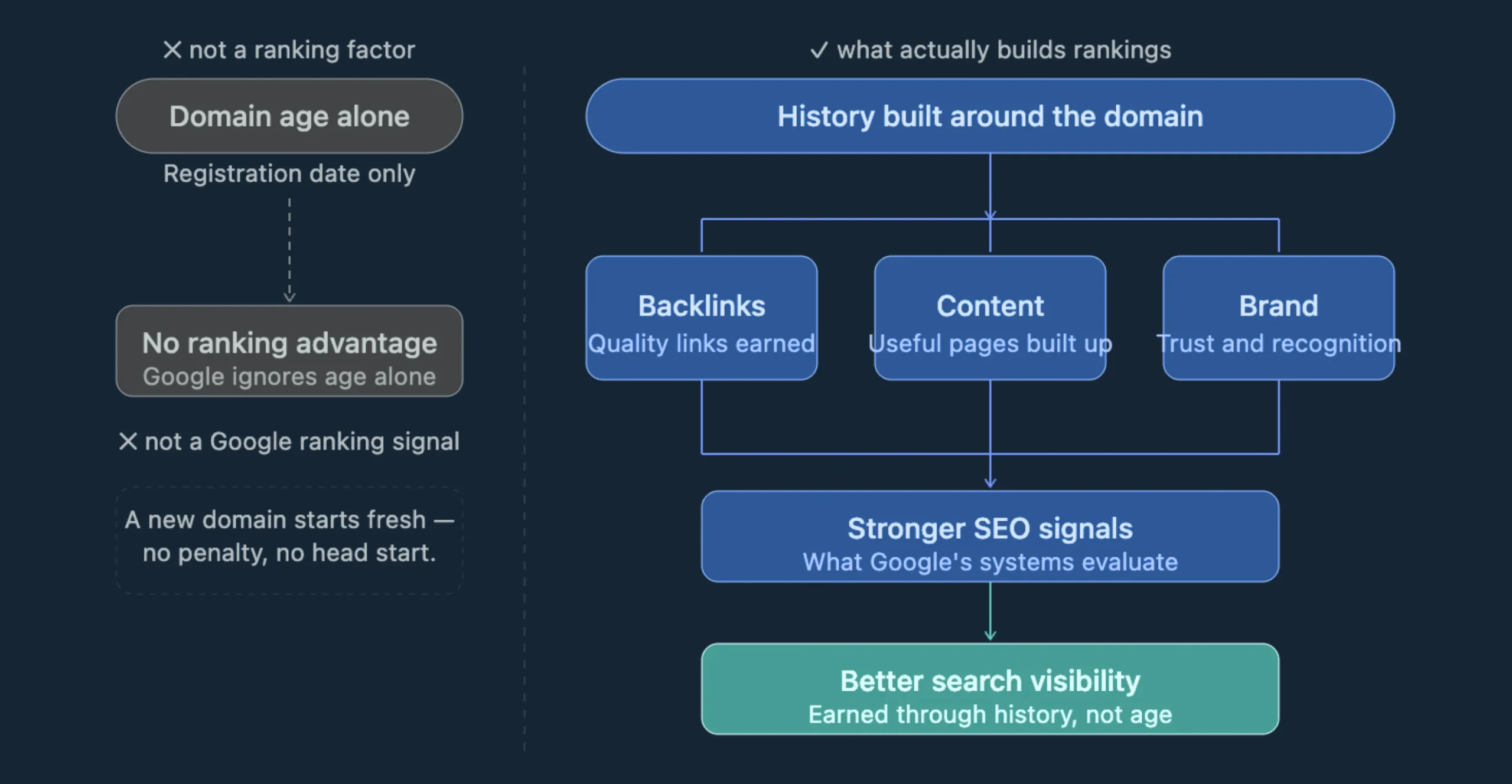
Not directly. The date a domain was registered isn’t, by itself, a ranking advantage.
What can make an older domain valuable is the useful history built around it over time. It may have earned quality backlinks, published relevant content, built a recognizable brand, and developed a genuine online presence.
Google uses many signals to decide which pages are relevant and useful for a search, rather than relying on one simple factor. So, definitely domain age is not a simple score that increases every year.
That distinction is important if you’re choosing between a new domain and an older one or looking to buy a domain that someone else previously owned.
Is Domain Age a Google Ranking Factor?
Google does not simply reward a website because its domain was registered years ago.
The registration date should not be treated as a ranking shortcut.
Former Google Webspam team leader Matt Cutts addressed domain age in a 2010 video, explaining that the difference between a domain that is six months old and one that is a year old is “really not that big at all.”
He also pointed to the quality of a website’s content and the links earned from that content as more important factors.
John Mueller, a Google’s Senior Webmaster Trends Analyst and Search Relations team lead, was even more direct in 2019. When asked if domain age could help build trust as a Google ranking signal, he responded, “No, domain age helps nothing.”
There is also an interesting experiment that supports this distinction.
Ted Kubaitis, an SEO software engineer and researcher, tested several thousand domains that had been registered in the 1990s but had never been used.
According to the reported results, Google treated those domains no differently from brand-new domains. In other words, being registered for decades did not give an unused domain an automatic ranking advantage.
These statements and experiment support an important distinction: Google does not give a website a ranking boost simply because its domain has been registered for a long time.
So, an older domain may have an advantage because of what it has built over the years, but the registration date itself isn’t the advantage.
Why old websites can still rank well
Here’s where most of the confusion starts.
People see older websites ranking highly, and because those sites have been around for years, they connect the dots: old domain equals higher ranking. But that skips the more important part of the story.
But years online only give a website more opportunities to build useful signals.
It may have published hundreds of helpful pages, earned links from relevant websites, built brand recognition, and developed a consistent presence in its industry.
Those things contribute to search performance. The registration date itself doesn’t provide the same benefit.
Why Does Domain Age SEO Seem Important, Then?
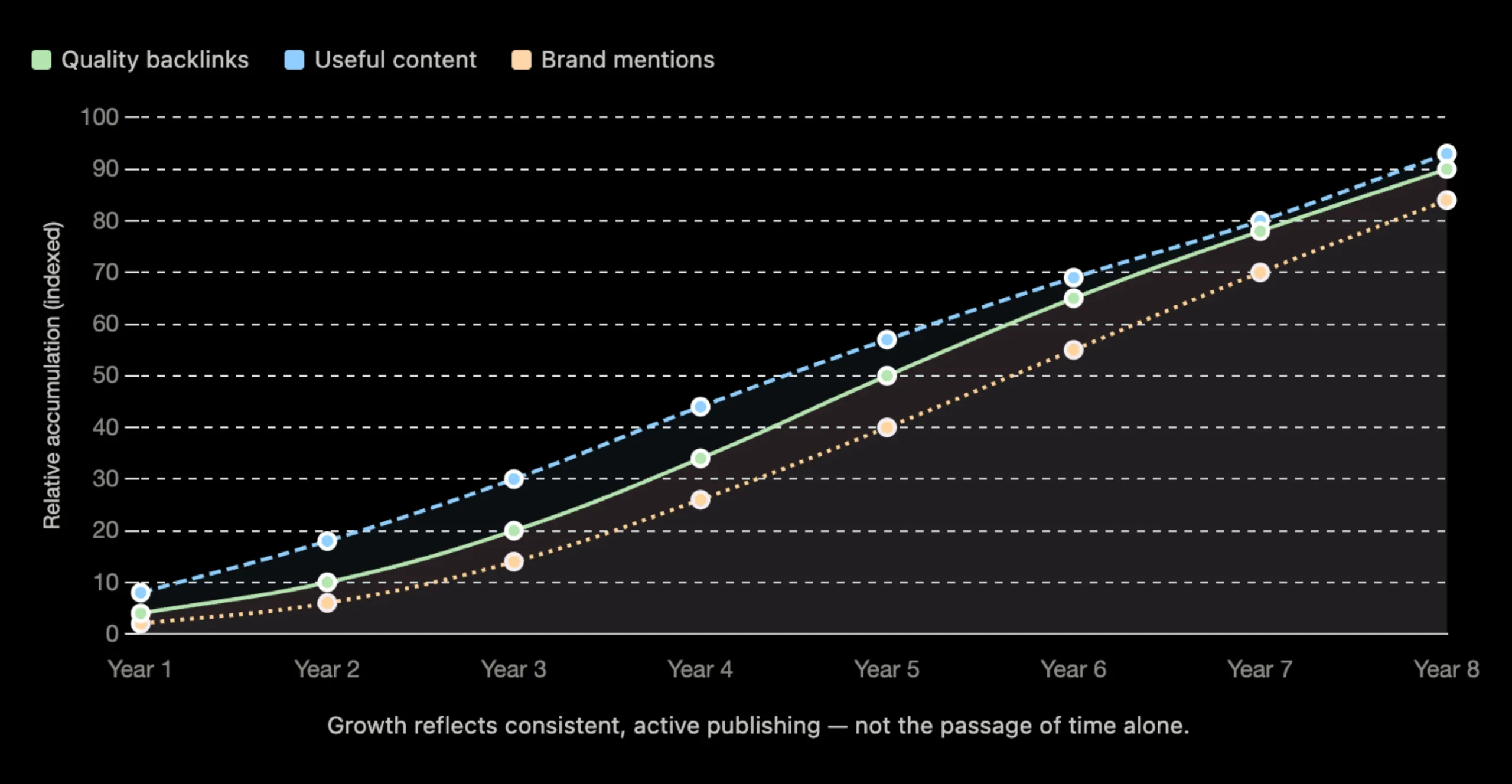
An established domain may have advantages that happen to correlate with age. The longer a website has been active, the more time it has had to build useful assets.
1) More time to earn quality backlinks
An established website has had longer to earn links from relevant websites.
For example, a website that consistently publishes useful guides, research, tools, or original information may naturally attract links from other sites. Over several years, those links can become part of its search presence.
Quality is important here, rather than simply having a large number of backlinks.
A 10-year-old domain with hundreds of irrelevant or low-quality links isn’t automatically stronger than a new domain with a smaller number of relevant, credible links.
Google recommends earning links naturally through useful, compelling content and warns against unnatural link schemes.
So, the potential benefit comes from the quality of links earned over time, not from the domain simply reaching a certain age.
2) More useful content and topical depth
Older websites may have accumulated articles, guides, product pages, FAQs, and other useful resources.
That gives them more opportunities to appear for relevant searches.
A website that has consistently covered one subject for years may also have content addressing many related questions around that topic.
But the content itself is what provides the value. An old page doesn’t become useful simply because it has been online for a long time.
A new website can also build topical depth by consistently publishing useful, relevant content.
3) Established brand recognition and mentions
A business that has operated online for years may have accumulated brand mentions and returning visitors.
People may already recognize the company, search for its name, visit its website directly, or mention its products and services elsewhere online.
These are signs of an established online presence.
They aren’t evidence of a special “old domain” ranking bonus. They are the result of a business being active and building a presence over time.
4) A history that supports the current website
The value of an older domain depends heavily on what happened on it before.
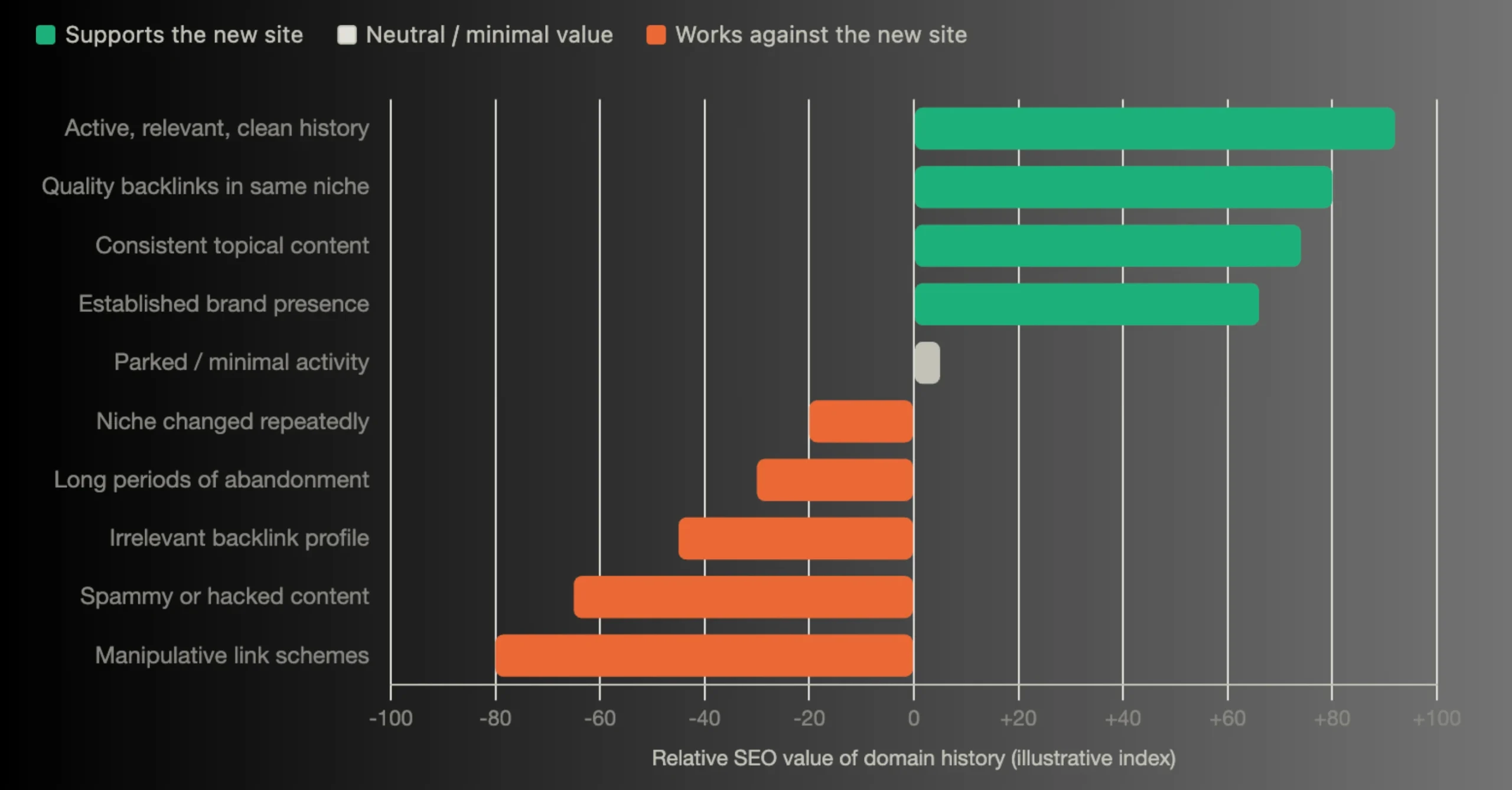
A domain that was used by a legitimate business, stayed focused on a relevant topic, published useful content, and earned genuine backlinks may have a history worth building on.
A domain that was registered years ago but barely used has a very different story.
That’s why domain age alone doesn’t tell you if an older domain is a good choice.
Can a New Domain Outrank an Older Domain?
A new domain isn’t automatically disadvantaged.
It can outrank an older one if its pages provide a better result for the search.
Google’s systems are designed to return relevant and useful results, and its guidance encourages helpful, reliable, people-first content.
For a new domain, the main focus should be on:
- Creating genuinely useful content
- Matching pages to what people are searching for
- Building a clear topical focus
- Earning relevant backlinks naturally
- Making the website accessible to search engines
- Providing a good experience for visitors
- Publishing and improving content consistently
Technical SEO is also important. Search engines need to be able to crawl and index your pages, while visitors need a website that works properly and loads well.
But you don’t need to wait five or 10 years before your website has a chance of ranking.
A new domain starts without an established history, but it also doesn’t start with an SEO penalty simply because it is new.
You can build its content, reputation, links, and audience from the ground up.
Does Buying an Aged Domain Give You an SEO Head Start?
Sometimes, but only if the domain’s history is genuinely useful.
An older domain may be worth considering when:
- It has a legitimate history.
- Its previous topic is relevant to the new website.
- It has earned quality, relevant backlinks.
- Its history shows genuine website activity rather than manipulation.
- Its existing reputation fits the new business.
Suppose you find a domain that is 12 years old. At first glance, that sounds valuable.
But what happened during those 12 years?
If the domain belonged to a legitimate business in the same industry, it may have useful content and links that are relevant to what you plan to build.
Now, an old domain isn’t automatically a good investment. If it was parked for most of that time, its age tells you very little.
And if it was used for spam, previous hacked or low-quality content, repeated changes in ownership or use, a completely different previous niche, long periods of abandonment, or manipulative link building, the old domain could create problems rather than give you a head start.
How Can You Check a Domain Before You Buy It?
If you’re considering an aged domain because you believe it could give you an SEO head start, don’t stop at the registration date.
Check the domain’s registration information.
A WHOIS lookup can help you check:
- Domain registration information
- Registrar
- Registration or creation date, where available
- Expiration date
- Domain status
- Other publicly available registration details
If you want to find out if a domain is genuinely old, the registration or creation date will clarify that. But while WHOIS can help get the registration information, it doesn’t tell you everything about a domain’s SEO history.
For a fuller assessment, also investigate other tools.
A Wayback Machine can show previous website content, its niche, and historical changes. Ahrefs can help you check backlinks and referring domains, while SEMrush can provide information about traffic, keywords, and search performance.
You can also use Google Search with site:domain.com to see which pages are currently indexed, along with spam-score tools to look for potential warning signs.
Use our Truehost Domains WHOIS Lookup to check available registration information before deciding what to do with the domain.
The Truehost WHOIS page is designed to help you look up available domain information, including registration details, expiry information, and registrar information.
Once you’ve confirmed the domain’s details and decided it’s the right fit, you can proceed to choose and register your domain right on our website.
Choose the domain’s history, not just its age.