 Domain SearchInstantly check and register your perfect .pk or international domain
 Web HostingGet a .pk domain for as low as PKR 467
 cPanel HostingUser-friendly hosting powered by cPanel
 Reseller HostingLaunch your own hosting business with minimal technical requirements
 Windows HostingOptimized for Windows-based applications and websites
 Affiliate ProgramEarn referral commissions by promoting our services
 WordPress HostingFast & Reliable WordPress Hosting
 Domain TransferMigrate your existing domain seamlessly with zero downtime.
 All DomainsAccess 324+ top-level domains (TLDs) worldwide from a single platform
 Whois LookupIdentify the owner of any domain using our whois and rdap lookup tool
 Managed VPS Hosting
 AI Website BuilderCreate beautiful websites effortlessly using intuitive drag-and-drop features
 Online ShopLaunch a professional online shop with no technical skills required
 BlogDiscover expert guides on hosting, websites, SEO, and digital growth strategies
 ContactGet instant assistance via live chat or email
 SupportAccess help articles, tutorials, and service documentation
 SSL CertificatesEncrypt data, build trust, and boost SEO.
Pakistan’s digital economy is growing quickly. Between January and March 2026, digital payments made up 92% of the country’s 3.7 billion retail transactions. This shows that online payments are now a normal part of doing business. Pakistan’s e-commerce market also grew from an estimated $7.7 billion in 2024 to $10.42 billion in 2025 and is expected to reach $12 billion by 2027.
The message is simple: customers are already online, so businesses need to be there too. But starting an online business involves more than creating a website. You need to register your business, decide where to sell, get a domain and professional email, set up payment options, arrange delivery, market your business, and follow the necessary rules.
This guide explains each step to help you turn your idea into a fully working online business in Pakistan.
Step 1: Register Your Business
Before you sell anything online, it’s worth putting the right legal foundation in place. This protects you, builds trust with customers and partners, and keeps you on the right side of tax law.
Choose the right structure. Most small businesses in Pakistan start as one of the following:
- Sole proprietorship: the simplest option, suited to freelancers and solo entrepreneurs who want to start quickly with minimal paperwork.
- Single Member Company (SMC): gives you the legal protection of a company while still being owned and run by one person.
- Private Limited Company: best if you plan to bring in partners, investors, or scale significantly.
Register with SECP if needed. If you choose to set up an SMC or Private Limited Company, you’ll register through the Securities and Exchange Commission of Pakistan’s (SECP) online portal. The basic process is straightforward: create an account, reserve your company name, submit the required documents, pay the registration fee, and receive your digital incorporation certificate. Sole proprietors don’t need to go through SECP at all.
Get your NTN. Every business, including sole proprietors and freelancers, should register for a National Tax Number (NTN) through the Federal Board of Revenue’s (FBR) IRIS portal. You don’t need a registered company to apply; individuals can obtain an NTN on their own.
Consider PSEB registration. If your business provides IT services, software development, or freelance work to clients outside Pakistan, registering with the Pakistan Software Export Board (PSEB) can unlock tax benefits and other advantages tailored to exporters of digital services.
Getting this foundation right early means you won’t have to pause and fix compliance issues later, when you’re busy handling orders and customers.
Step 2: Choose How You Will Sell Online
There’s no single “correct” way to sell online; the right approach depends on your budget, your product, and how much control you want over the customer relationship.
- Marketplace selling. Platforms like Daraz let you list products with relatively little setup. You get access to an existing customer base and built-in trust, but you’ll compete on the same platform as other sellers and have less control over branding.
- Your own online store. Building on Shopify or WooCommerce gives you full control over branding, customer data, and the buying experience, but it takes more upfront work to set up and market.
- Social commerce. Selling directly through Instagram, Facebook, TikTok, and WhatsApp requires almost no upfront investment and lets you start taking orders immediately, a popular route for businesses testing a new product before committing to a full store.
Many businesses in Pakistan use a mix of these, for example, starting on social media to validate demand, then layering in a marketplace presence and eventually a dedicated store as the business grows.
Step 3: Get a Domain and Hosting
Your domain name is often a customer’s first impression of your business, so it’s worth choosing carefully.
Pick the right domain extension. A .pk or .com.pk domain signals that you’re a Pakistani business and can help build local trust, especially if most of your customers are within the country. A .com domain is generally better suited if you’re targeting an international audience or plan to expand beyond Pakistan.
You’ll need to register your domain through an accredited reseller such as Truehost, where a .pk domain currently costs ₨54,721.04 per year.

Choose hosting that matches your needs:
- Shared hosting: a cost-effective option well suited to small websites and businesses just getting started.
- Managed or e-commerce hosting: designed for growing online stores that need more resources, better uptime, and easier scaling.
- Shopify hosting: if you build your store on Shopify, hosting is bundled into the platform, so there’s nothing separate to set up.
Getting the domain and hosting combination right from the start avoids the hassle of migrating your site later as your traffic grows.
Step 4: Set Up a Professional Email Address
It’s a small detail that makes a big difference: a branded email address like [email protected] builds far more trust with customers than a free Gmail or Yahoo address ever will.
A professional email address also signals to suppliers, customers, and partners that your business is established and serious, something that counts when you’re negotiating deals or handling customer complaints.
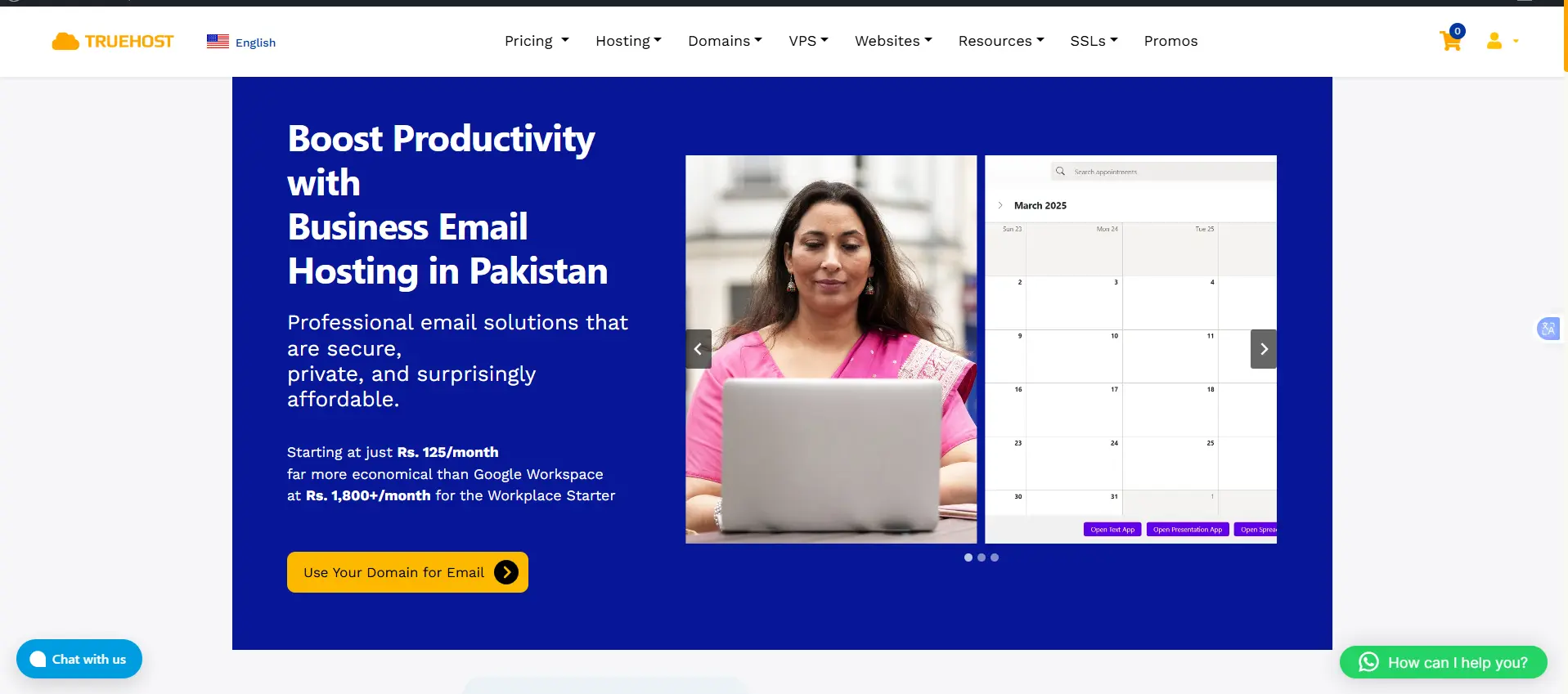
Truehost’s business email hosting makes this easy to set up, with options for webmail access so you can check messages from a browser, mobile and desktop sync so your email stays consistent across devices, and spam protection to keep your inbox clean.
Step 5: Build Your Online Store
With your registration, domain, hosting, and email in place, it’s time to build the storefront itself. Your choice of platform should match the stage your business is at:
- Shopify: easy to set up and manage, with a large ecosystem of apps and themes. A strong choice if you want to launch quickly without technical overhead.
- WooCommerce: a flexible, highly customizable option built on WordPress, better suited to businesses with some technical support who want more control over design and functionality.
- Daraz: a solid choice if your priority is reaching Pakistan’s largest existing marketplace audience rather than building an independent brand.
- Social media: the simplest starting point, ideal for testing whether there’s demand for your product before investing in a full store.
If you’re working with a small budget, a practical path is to start with Instagram and WhatsApp Business, use that to validate your product and pricing, and reinvest early profits into building a full online store as sales grow.
Step 6: Set Up Payment Methods
Give your customers as many convenient ways to pay as possible. In Pakistan, this typically means offering:
- JazzCash
- Easypaisa
- Bank transfers
- Raast (Pakistan’s instant payment system)
- Debit and credit cards
- Cash on delivery (COD)
Cash on delivery remains common across Pakistan, particularly outside major cities, so it’s worth keeping as an option even as digital payments grow. That said, COD carries its own risks, with refused or returned orders being the most common, so many businesses offer a small discount or incentive for customers who pay in advance, encouraging a gradual shift toward digital payments.
If you plan to sell to customers outside Pakistan, check in advance which payment gateways and receiving options are actually available and compliant for your business type and target market, since cross-border payment support varies by provider.
Step 7: Arrange Delivery and Fulfillment
A great online store means little if orders don’t arrive reliably. Choosing the right courier or logistics partner is one of the most consequential operational decisions you’ll make.
Common courier and logistics providers in Pakistan include:
- TCS
- Leopards
- PostEx
- M&P
- Trax
When comparing providers, weigh:
- Delivery charges: these affect your margins directly, especially on lower-priced products.
- Delivery times: faster delivery tends to improve conversion and reduce cancellations.
- COD support: not all couriers handle cash collection the same way, so confirm this if COD is central to your business.
- Order tracking: customers increasingly expect to track their orders in real time.
- Return handling: a smooth returns process protects your reputation and reduces disputes.
- Coverage outside major cities: if you’re aiming for nationwide reach, make sure your courier actually delivers beyond Karachi, Lahore, and Islamabad.
Many growing businesses use more than one courier to balance cost, speed, and coverage across different regions.
Step 8: Market Your Business
Once your store is live, the real work of getting customers begins. A well-rounded marketing approach usually combines several channels rather than relying on just one:
- SEO: optimizing your site so it appears in Google searches for the products and services you sell, building long-term, low-cost traffic.
- Social media promotion: Facebook, Instagram, and TikTok remain some of the most effective channels for reaching Pakistani consumers, particularly younger and mobile-first audiences.
- WhatsApp Business: an essential tool for communicating directly with customers, confirming orders, and handling support in a channel people already use daily.
- Paid ads: once you have a clear product-market fit and understand your target audience, paid advertising can accelerate growth efficiently.
- Content marketing: publishing useful, relevant content builds trust with potential customers and supports your SEO efforts at the same time.
The most effective strategy usually starts small: one or two channels done well, and expands as you learn what resonates with your specific customers.
Step 9: Build Trust and Stay Compliant
Customers need to feel safe buying from you, especially if you’re a newer or lesser-known brand. A few fundamentals go a long way:
- Use SSL/HTTPS on your website so customer data is encrypted in transit.
- Display clear contact information, including a phone number and email address customers can actually reach.
- Show your business details; registration information, address, or other credentials, where appropriate, to reinforce legitimacy.
- Provide clear shipping, return, refund, and privacy policies, written in plain language rather than buried in legal jargon.
- Keep your tax and business records up to date to avoid compliance issues down the line.
- Protect customer information and secure your website against common vulnerabilities, especially as you start collecting payment and personal data.
These steps count more than many new business owners expect; a professional, trustworthy storefront is often the difference between a visitor who buys and one who leaves without completing checkout.
Common Mistakes to Avoid
Even well-planned online businesses run into avoidable problems. Watch out for these common pitfalls:
- Underestimating COD returns. Customers may refuse or return cash-on-delivery orders more often than expected, so build this risk into your planning and pricing.
- Choosing Shopify without a payment plan. Make sure your payment gateway is fully set up and tested before you launch, a broken checkout is one of the fastest ways to lose sales.
- Ignoring mobile users. With the majority of online shoppers in Pakistan browsing and buying from their phones, a website or checkout that doesn’t work well on mobile will cost you sales.
- Ignoring social commerce. Platforms like Instagram, Facebook, TikTok, and WhatsApp aren’t just marketing channels; for many Pakistani businesses, they’re a primary sales channel in their own right.
Take Your Pakistani Business Online Today
Getting your business online in Pakistan isn’t a single task; it’s a sequence of smaller, manageable steps: registering properly, choosing where to sell, setting up your domain and hosting, building your store, enabling the right payment and delivery options, and marketing consistently. Each step builds on the last, and you don’t need to do everything at once. Start with what your budget and time allow, and expand as your business grows.
One of the simplest ways to start is with a professional email address on your own domain; it’s quick to set up and instantly makes your business look more credible to customers, suppliers, and partners. Get your business email hosting with Truehost.pk and take the first step toward a more trustworthy online presence.
How to Get Your Business Online in Pakistan: FAQs
Can I register my business online in Pakistan?
Yes. Sole proprietors can register for an NTN directly through FBR’s IRIS portal without forming a company. If you want to set up a Single Member Company or Private Limited Company, you can complete the entire registration process online through SECP’s e-services portal, from name reservation to receiving your digital incorporation certificate.
What is the best online business to start in Pakistan?
There’s no single “best” option, it depends on your resources and interests. Popular starting points include reselling through social commerce (Instagram, Facebook, TikTok, WhatsApp), dropshipping or private-label products through Shopify or WooCommerce, marketplace selling on Daraz, and freelance or IT services exported internationally through PSEB-registered businesses.
How do I start my first online business?
Start by registering your business and getting an NTN, then choose a low-cost way to sell, social commerce or a marketplace like Daraz are good starting points that don’t require a large upfront investment. Validate that people want to buy your product before investing in a full website, domain, and hosting setup.
Which business can I open online?
Common categories for new online businesses in Pakistan include fashion and apparel, electronics accessories, beauty and personal care products, home goods, food and grocery delivery, and digital or freelance services. The right choice depends on your supply chain access, budget, and target customers.
How much does it cost to put a business online in Pakistan?
Costs vary widely depending on your approach. A basic setup, a domain, shared hosting, and a simple store, can cost relatively little per year, while a fully custom store with paid marketing, professional photography, and a dedicated logistics setup will cost significantly more. Starting with social commerce keeps upfront costs close to zero while you validate demand.
Can I sell to customers outside Pakistan?
Yes, but you’ll need to check which payment gateways and receiving methods are available and compliant for cross-border transactions, since not all local payment providers support international customers. PSEB registration can also be worthwhile if you’re exporting IT or freelance services specifically.
How do I get my business found on Google?
Focus on basic SEO fundamentals: use clear, keyword-relevant product and page titles, write original product descriptions rather than copying supplier text, make sure your site loads quickly and works well on mobile, and build a small library of helpful content related to what you sell. Combining this with an active social media presence and word-of-mouth referrals will help your business surface in both search and social discovery.